Showing posts with label planning. Show all posts
Showing posts with label planning. Show all posts
Wednesday, 24 October 2012
Urban expansion: learning from 19th century London
Paul Collier says that African cities should learn from the example of 19th century London when it comes to housing policy. London was able to build decent housing for working people because its building regulations weren't onerously high, because landowners split their land up into separate plots for small firms to build out while retaining ownership themselves, and because the legal system of ownership and tenure was clear enough to allow building societies to lend with confidence.
All good points, but I would just a couple of things. First, 19th century London also benefitted from rapidly falling transport costs, which enabled development to take place on greenfield land. Stagnation in transport technology makes it harder to keep expanding the urban frontier and compels us to try and redevelop existing urban areas.
Also, it's not just African cities but 21st century English cities which could learn from the example of Victorian London, in particular on the land ownership front. What usually happens these days is that a developer buys a large site and then waits for the most opportune moment to develop the whole thing, which can take a long time. This arrangement means you are basically creating a local land monopolist, with all the problems that entails. Ideally, government should instead try to split the task of building the site out between a number of smaller firms, who would then be competing against each other, which should raise both the timeliness and the quality of development. Obviously this is much harder when government doesn't own the land, although the German practice of umlegung (land assembly) seems to be a reasonably close approximation.

Sunday, 14 October 2012
If you like your neighbourhood so much then let more people live there
Matt Yglesias has an excellent post here about the lovely city of Santa Monica, which prides itself on its greenness yet has seen barely any population growth in recent decades despite sky-high house prices.
For Santa Monica you can subsitute any number of nice, exclusive places in the US and across Europe. Here in London we have an excellent example in the Royal Borough of Kensington and Chelsea, where the average house price is over a million pounds (pdf) but where the population and the number of households actually fell, albeit only slightly, between the 2001 and 2011 censuses compared to an increase of 8.3% across London as a whole (xls).
Demand for housing in K&C is clearly through the roof, so how come its population isn't growing? The reason is that planning policy, backed up with overwhelming political support from borough residents, makes it very difficult to build any new housing in the area. So very little does get built, so rising demand just pushes up prices.
K&C is a somewhat extreme example (70% of it is in a conservation area!) but the general pattern is widespread. More people want to move to urban areas to be closer to job opportunities or to avail of improvign urban environments, but the people who are already there don't want their neighbourhood to change so they campaign against new housing developments, and politicians dutifully vote those developments down. The supply shortfall pushes up prices, so only the richest can afford to move in and those less well-off either stay put or move to somewhere less nice and/or further out.
I think this is quite a bad situation, because it results in affordability problems, greater segregation by income and environmentally damaging urban sprawl as housing supply is diverted to places further away from jobs and services. And indeed, you hear a lot of concern about these issues in urban political discourse - but what you generally don't hear is any connection being made with all those anti-development crusades that contribute so much to the problems.
Of course there may be downsides to densification of existing urban neighbourhoods in response to rising demand. A lovely neighbourhood may not look quite as lovely when it's had some buildings replaced or some blocks of flats added. Personally I think these things can go either way and some areas would be much improved by densification, but I also think these basically aesthetic considerations are just not that important compared to the effect on people's lives of making more housing available in places where they want to live.
At its root, this is an issue of social justice and of personal ethics. People who care about social justice should be worried about a political process which gives all the power to people who already inhabit a neighbourhood and none to the people who would like to (see Matt Yglesias again). And people who think of themselves as ethical should ask themselves whether they can justify excluding others from enjoying the same neighbourhood they like so much, while adding to our already serious problems of affordability and car-dependent development.
For Santa Monica you can subsitute any number of nice, exclusive places in the US and across Europe. Here in London we have an excellent example in the Royal Borough of Kensington and Chelsea, where the average house price is over a million pounds (pdf) but where the population and the number of households actually fell, albeit only slightly, between the 2001 and 2011 censuses compared to an increase of 8.3% across London as a whole (xls).
Demand for housing in K&C is clearly through the roof, so how come its population isn't growing? The reason is that planning policy, backed up with overwhelming political support from borough residents, makes it very difficult to build any new housing in the area. So very little does get built, so rising demand just pushes up prices.
K&C is a somewhat extreme example (70% of it is in a conservation area!) but the general pattern is widespread. More people want to move to urban areas to be closer to job opportunities or to avail of improvign urban environments, but the people who are already there don't want their neighbourhood to change so they campaign against new housing developments, and politicians dutifully vote those developments down. The supply shortfall pushes up prices, so only the richest can afford to move in and those less well-off either stay put or move to somewhere less nice and/or further out.
I think this is quite a bad situation, because it results in affordability problems, greater segregation by income and environmentally damaging urban sprawl as housing supply is diverted to places further away from jobs and services. And indeed, you hear a lot of concern about these issues in urban political discourse - but what you generally don't hear is any connection being made with all those anti-development crusades that contribute so much to the problems.
Of course there may be downsides to densification of existing urban neighbourhoods in response to rising demand. A lovely neighbourhood may not look quite as lovely when it's had some buildings replaced or some blocks of flats added. Personally I think these things can go either way and some areas would be much improved by densification, but I also think these basically aesthetic considerations are just not that important compared to the effect on people's lives of making more housing available in places where they want to live.
At its root, this is an issue of social justice and of personal ethics. People who care about social justice should be worried about a political process which gives all the power to people who already inhabit a neighbourhood and none to the people who would like to (see Matt Yglesias again). And people who think of themselves as ethical should ask themselves whether they can justify excluding others from enjoying the same neighbourhood they like so much, while adding to our already serious problems of affordability and car-dependent development.
Tuesday, 9 October 2012
A land value tax would be unpopular for the same reasons that it would be great
I was surprised a while back to find that the Liberal Democrat conference policy paper on housing included a call for a land value tax (LVT), because the current party leadership shows absolutely no interest in implementing one. But then LVT has long been a cause beloved of earnest policy wonks and loathed by politicos. I'll get to why that is in a moment, but first it's worth rehearsing what I like to call the neoliberal-environmentalist-progressive case for an LVT.
An LVT is a tax on the value of land, excluding the value of anything built on it. The logic is that the relative value of different plots of land is nothing to do with the landowner's activities but is purely a product of their locations and the access they grant to amenities, infrastructure and other 'locational goods'. And because land is fixed in supply and location, taxing it doesn't have the distortionary effects that taxing income or consumption might. So because the community effectively creates the value of land, the community should also draw the benefit rather than let landlords get rich by doing nothing.
Part of the attraction - for policy wonks - of an LVT is that it would provide an incentive for valuable land to be used for its most productive purpose. So if you own a plot of land in a great location, the high tax on it gives you a very strong incentive to get as much money out of that site as possible, which might mean building offices or housing or whatever - the point is that you do with that land whatever maximises its value, subject to whatever constraints the planning system sets . This outcome is good for the landowner (who reduces their net tax bill), good for the government (who gets the tax revenues) and good for whoever ends up occupying the buildings on the land, as they get homes or workplaces they would otherwise not have.
But as DuncanStott Stoddard points out on the IEA blog, there is a significant problem here, in that current planning policy in this country (and most others) is mainly concerned with restricting landowners' abilities to maximise income from their land by building stuff on it. Building something a bit taller than the surrounding buildings is basically illegal across large swathes of this country, as is switching uses from residential to commercial or whatever. Retaining these extremely strict regulations on land use would negate much of the benefit of an LVT. In fact, it would arguably make an LVT quite unjust, in that you would be increasing some people's tax bills while preventing them increasing the income from their land to compensate.
So as Duncan says, an LVT should really go hand in hand with looser planning regulations. That way you maximise both the benefits of an LVT and the benefits of looser planning - the latter because if you loosen up planning policy without an LVT you are basically enriching landowners (by increasing their potential income) again without them having done anything to deserve it. And allowing landowners with valuable land to build lots of housing on it also means that if they pass the cost of their LVT onto those who occupy the land (i.e. tenants or apartment owners), then obviously the more occupiers there are the lower the cost is for each of them. This can mean that the per-household LVT is significantly lower in city centres than it is in the suburbs - which is also a benefit, since people living at higher densities are imposing fewer costs on the community in terms of infrastructure requirements, energy use and so on.
So a combination of a land value tax and looser planning regulations would very likely deliver cheaper housing, more tax revenues, a fairer distribution of wealth, a shift in the tax system away from distortionary income taxes, and a more sustainable and energy-efficient pattern of land use. Who wouldn't want that?
Lots of people, it turns out. In particular you've got all those homeowners who bought into a neighbourhood which then improves around them, driving up the value of their property and generally making them very happy with their lot. Coming along and telling them that actually they should pay a bit more for their good fortune and perhaps consider building a block of flats on their land will probably have this large and vocal constituency reaching for the pitchforks. But as well as the people who have got lucky in the property market, an LVT will probably also incite the ire of anyone who aspires to get lucky in the property market, which is to say pretty much everyone.
After all, just about everyone everyone wants to be that person who buys a property and sees it rocket in value through no skill or effort of their own. Yes it's unearned wealth and so policy wonks will say it raises important issues of social justice and economic efficiency and yadda yada, but everyone wants to achieve huge wealth, preferably without earning it. An LVT says nobody should get away with amassing unearned wealth through locational good fortune without paying some appropriate fee to providence. In other words, it is an attempt to put a stop to free lunches via the property market. But people like free lunches, and if they don't currently have access to one they like to think that some day they will. And that, it seems to me, is why politicians are scared of land value taxation.
Neverthless, I do think the world would be a better place if we had more land value taxation, and it could happen if enough people get behind it and crank up the machinery of persuasion. Environmentalists, progressives, tall-building aficionados and tax reformers should recognise the benefits, hold their noses and start forming coalitions to lobby for this, because our leaders are going to require a lot of persuading.
An LVT is a tax on the value of land, excluding the value of anything built on it. The logic is that the relative value of different plots of land is nothing to do with the landowner's activities but is purely a product of their locations and the access they grant to amenities, infrastructure and other 'locational goods'. And because land is fixed in supply and location, taxing it doesn't have the distortionary effects that taxing income or consumption might. So because the community effectively creates the value of land, the community should also draw the benefit rather than let landlords get rich by doing nothing.
Part of the attraction - for policy wonks - of an LVT is that it would provide an incentive for valuable land to be used for its most productive purpose. So if you own a plot of land in a great location, the high tax on it gives you a very strong incentive to get as much money out of that site as possible, which might mean building offices or housing or whatever - the point is that you do with that land whatever maximises its value, subject to whatever constraints the planning system sets . This outcome is good for the landowner (who reduces their net tax bill), good for the government (who gets the tax revenues) and good for whoever ends up occupying the buildings on the land, as they get homes or workplaces they would otherwise not have.
But as Duncan
So as Duncan says, an LVT should really go hand in hand with looser planning regulations. That way you maximise both the benefits of an LVT and the benefits of looser planning - the latter because if you loosen up planning policy without an LVT you are basically enriching landowners (by increasing their potential income) again without them having done anything to deserve it. And allowing landowners with valuable land to build lots of housing on it also means that if they pass the cost of their LVT onto those who occupy the land (i.e. tenants or apartment owners), then obviously the more occupiers there are the lower the cost is for each of them. This can mean that the per-household LVT is significantly lower in city centres than it is in the suburbs - which is also a benefit, since people living at higher densities are imposing fewer costs on the community in terms of infrastructure requirements, energy use and so on.
So a combination of a land value tax and looser planning regulations would very likely deliver cheaper housing, more tax revenues, a fairer distribution of wealth, a shift in the tax system away from distortionary income taxes, and a more sustainable and energy-efficient pattern of land use. Who wouldn't want that?
Lots of people, it turns out. In particular you've got all those homeowners who bought into a neighbourhood which then improves around them, driving up the value of their property and generally making them very happy with their lot. Coming along and telling them that actually they should pay a bit more for their good fortune and perhaps consider building a block of flats on their land will probably have this large and vocal constituency reaching for the pitchforks. But as well as the people who have got lucky in the property market, an LVT will probably also incite the ire of anyone who aspires to get lucky in the property market, which is to say pretty much everyone.
After all, just about everyone everyone wants to be that person who buys a property and sees it rocket in value through no skill or effort of their own. Yes it's unearned wealth and so policy wonks will say it raises important issues of social justice and economic efficiency and yadda yada, but everyone wants to achieve huge wealth, preferably without earning it. An LVT says nobody should get away with amassing unearned wealth through locational good fortune without paying some appropriate fee to providence. In other words, it is an attempt to put a stop to free lunches via the property market. But people like free lunches, and if they don't currently have access to one they like to think that some day they will. And that, it seems to me, is why politicians are scared of land value taxation.
Neverthless, I do think the world would be a better place if we had more land value taxation, and it could happen if enough people get behind it and crank up the machinery of persuasion. Environmentalists, progressives, tall-building aficionados and tax reformers should recognise the benefits, hold their noses and start forming coalitions to lobby for this, because our leaders are going to require a lot of persuading.
Friday, 7 October 2011
The localist trilemma
Prof Henry Overman of the LSE has some interesting thoughts on lessons for urban policy from Dani Rodrik's book 'The Globalization Paradox'. I'm particularly interested in Rodrik's concept of an inescapable trilemma governing world economic affairs, according to which "democracy, national sovereignty and global economic integration are mutually incompatible: we can combine any two of the three, but never have all three simultaneously and in full". Or in graphic form:

I wonder whether a similar logic applies to 'localism' and land use policy, as follows
Or if you prefer the graphic version:
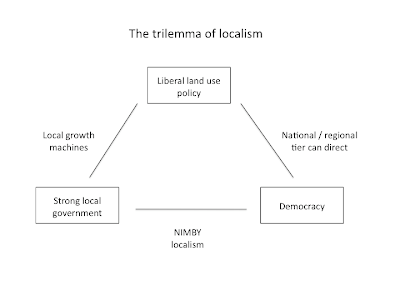 No doubt this is a little too neat, but I think there's something to it. Which is troubling for people who like all three things in those boxes.

I wonder whether a similar logic applies to 'localism' and land use policy, as follows
- Strong local governments which are also very responsive to the local electorate are more likely to be NIMBYist;
- If you want to combine democratic institutions and liberal land use policy you probably need relatively weak local government, with wider interests represented by elected regional or national tiers promoting growth over local resistance;
- And if you want strong local government combined with liberal land use policy then a somewhat undemocratic 'local growth machine' is perhaps the best way to get it.
Or if you prefer the graphic version:

Monday, 19 September 2011
The Gated City
I've just finished reading Ryan Avent's book The Gated City, which UK readers can download for Kindle or PC/Mac reading here. Anyone interested in why we've got cities in the first place, how we ended up with the ones we have, or what's going to happen to them in future should read it. In an appealingly concise ninety or so pages, you get a very clear explanation of the economic advantages of density, a compelling argument that restricting density leads to significant damage to economic growth prospects as well as social costs, and a critique of the ethics of NIMBYism which is all the more persuasive because it is so even-handed.
For a short book it raises a lot of issues, but I'm going to focus on just one or two. Firstly - and maybe this isn't a particularly fair comment on a deliberately brief tome - at some point I'd like to see a deeper exploration of why so many people have come to oppose development so much. After all, it was only as recently as the mid-1970s that Harvey Molotch was writing about how American cities were controlled by 'local growth machines', mostly driven by real estate developers, that rode roughshod over the interests of ordinary residents.
In a way, it's these growth machines that seem hard to explain now. You can see why residents wanted more control, even leaving aside some of the crimes committed in the name of urban redevelopment. It is natural to want to influence what happens to our neighbourhood, since it affects our quality of life so deeply. It is all the more natural if we are particularly attached to our neighbourhood, if it is particularly unique and attractive, or if our major asset's value is intimately tied to it (in practice, these different factors may be difficult to disentangle). Perhaps NIMBYism, like cleaner environments and longer holidays, is something that we choose to have more of as we become more affluent, even if it comes at the cost of lower overall economic growth (I say 'we', but of course as Ryan says there are real clashes of interest and distributional consequences involved).
And the thing is, falling urban densities over the course of the 20th century did seem to be accompanied by real improvements in quality of life. Present day San Francisco is an extraordinarily pleasant place. So why should those who have paid so much for the pleasure of living there have to accept it being changed, perhaps destroyed?
The Gated City is about answering that question from the perspective of society at large, and it answers it very well. But as persuasive as this rootless technocrat found it I don't think it will win over your average NIMBY in San Jose or Chelsea. So what would work? Ryan mainly suggests radically narrowing the scope of planning rules and respecting the right of people to do what they like with their property, and 'zoning budgets' so that local authorities can't restrict development in one place without freeing it up elsewhere.
I'm not sure about these. One problem with trying to radically limit the role of planning is that restrictive rules are typically extremely popular with local people, so removing them implies some sort of top-down direction that, however beneficial in the aggregate, is likely to cause a good deal of strife. Secondly, I think there is a role for planning in that there really are large potential social costs involved with development which good planning can address. There's a danger that removing the system's ability to address these externalities would just lead to more development with high social costs. The problem is that the role of planning has been left open to addressing any kind of 'impact', so people complain on purely private grounds, albeit sometimes dressed up in social terms. Perhaps I'm naive or just speaking my class interests as a sometime-planner (by the way, see the disclosure at the end of the post), but I'd like to see more of an effort to make it clearer which external costs planning can and should address and what the evidential thresholds for complaints should be before we chuck out planning altogether. As for zoning budgets, unless I'm missing something they don't seem to me to really address the legacy of existing constraints.
So what's left? I do think we could look at ways of ensuring that expensive and restrictive neighbourhoods bear more of the costs of their restrictions, which at the moment are mainly borne by others. In this country the new government has introduced a New Homes Bonus which pays local authorities for each new home completed in their area by matching the council tax income for the new home for the first six years. This will provide some additional incentive to increase supply, but the problem is that if supply increases to anything like the levels we need, much of the funding for the NHB will come from top-slicing central government grant to councils in proportion to the amount they currently receive. This means that those councils most dependent on government grant (i.e. those in deprived areas) will pay more for the NHB (if it ever takes off), unless they can get a lot of homes built themselves. In effect therefore, the strongest incentives tend to apply in the areas with lowest market demand.
I've argued that you could redesign the NHB so that it is paid for by top-slicing grant to councils in proportion to the extent of the affordability problem in each area. That would mean that the areas with highest prices relative to incomes will not just earn no NHB if they don't allow new supply, but would lose out the most in proportionate terms to those councils that are building. At the right rates this could be a sharp incentive indeed, perhaps enough to concentrate minds in some expensive areas places (this is also not a million miles from Glaeser & Gyourko's proposal of a few years back).
Now, that's obviously fairly top-down too. And anything that challenges the status quo enough to really make a change is going to be controversial and hard to implement for precisely that reason. The first step has to be to face up to the real magnitude of the costs we impose on ourselves by unduly limiting densities, and for that reason The Gated City deserves to be read very widely.
Disclosure: This post, like everything else on this blog, is informed by my work at the Greater London Authority on housing and planning policy - as a fairly minor functionary rather than someone with much decision-making power. The big decisions are naturally made by the Mayor and his advisors, taking into account a range of factors which I have the luxury of not having to deal with. Just in case it isn't clear, I'm writing in a completely personal capacity here.
For a short book it raises a lot of issues, but I'm going to focus on just one or two. Firstly - and maybe this isn't a particularly fair comment on a deliberately brief tome - at some point I'd like to see a deeper exploration of why so many people have come to oppose development so much. After all, it was only as recently as the mid-1970s that Harvey Molotch was writing about how American cities were controlled by 'local growth machines', mostly driven by real estate developers, that rode roughshod over the interests of ordinary residents.
In a way, it's these growth machines that seem hard to explain now. You can see why residents wanted more control, even leaving aside some of the crimes committed in the name of urban redevelopment. It is natural to want to influence what happens to our neighbourhood, since it affects our quality of life so deeply. It is all the more natural if we are particularly attached to our neighbourhood, if it is particularly unique and attractive, or if our major asset's value is intimately tied to it (in practice, these different factors may be difficult to disentangle). Perhaps NIMBYism, like cleaner environments and longer holidays, is something that we choose to have more of as we become more affluent, even if it comes at the cost of lower overall economic growth (I say 'we', but of course as Ryan says there are real clashes of interest and distributional consequences involved).
And the thing is, falling urban densities over the course of the 20th century did seem to be accompanied by real improvements in quality of life. Present day San Francisco is an extraordinarily pleasant place. So why should those who have paid so much for the pleasure of living there have to accept it being changed, perhaps destroyed?
The Gated City is about answering that question from the perspective of society at large, and it answers it very well. But as persuasive as this rootless technocrat found it I don't think it will win over your average NIMBY in San Jose or Chelsea. So what would work? Ryan mainly suggests radically narrowing the scope of planning rules and respecting the right of people to do what they like with their property, and 'zoning budgets' so that local authorities can't restrict development in one place without freeing it up elsewhere.
I'm not sure about these. One problem with trying to radically limit the role of planning is that restrictive rules are typically extremely popular with local people, so removing them implies some sort of top-down direction that, however beneficial in the aggregate, is likely to cause a good deal of strife. Secondly, I think there is a role for planning in that there really are large potential social costs involved with development which good planning can address. There's a danger that removing the system's ability to address these externalities would just lead to more development with high social costs. The problem is that the role of planning has been left open to addressing any kind of 'impact', so people complain on purely private grounds, albeit sometimes dressed up in social terms. Perhaps I'm naive or just speaking my class interests as a sometime-planner (by the way, see the disclosure at the end of the post), but I'd like to see more of an effort to make it clearer which external costs planning can and should address and what the evidential thresholds for complaints should be before we chuck out planning altogether. As for zoning budgets, unless I'm missing something they don't seem to me to really address the legacy of existing constraints.
So what's left? I do think we could look at ways of ensuring that expensive and restrictive neighbourhoods bear more of the costs of their restrictions, which at the moment are mainly borne by others. In this country the new government has introduced a New Homes Bonus which pays local authorities for each new home completed in their area by matching the council tax income for the new home for the first six years. This will provide some additional incentive to increase supply, but the problem is that if supply increases to anything like the levels we need, much of the funding for the NHB will come from top-slicing central government grant to councils in proportion to the amount they currently receive. This means that those councils most dependent on government grant (i.e. those in deprived areas) will pay more for the NHB (if it ever takes off), unless they can get a lot of homes built themselves. In effect therefore, the strongest incentives tend to apply in the areas with lowest market demand.
I've argued that you could redesign the NHB so that it is paid for by top-slicing grant to councils in proportion to the extent of the affordability problem in each area. That would mean that the areas with highest prices relative to incomes will not just earn no NHB if they don't allow new supply, but would lose out the most in proportionate terms to those councils that are building. At the right rates this could be a sharp incentive indeed, perhaps enough to concentrate minds in some expensive areas places (this is also not a million miles from Glaeser & Gyourko's proposal of a few years back).
Now, that's obviously fairly top-down too. And anything that challenges the status quo enough to really make a change is going to be controversial and hard to implement for precisely that reason. The first step has to be to face up to the real magnitude of the costs we impose on ourselves by unduly limiting densities, and for that reason The Gated City deserves to be read very widely.
Disclosure: This post, like everything else on this blog, is informed by my work at the Greater London Authority on housing and planning policy - as a fairly minor functionary rather than someone with much decision-making power. The big decisions are naturally made by the Mayor and his advisors, taking into account a range of factors which I have the luxury of not having to deal with. Just in case it isn't clear, I'm writing in a completely personal capacity here.
Wednesday, 14 September 2011
Empty homes not to the rescue
Simon Jenkins attacks the NPPF again, and as before the effect is to make you wonder if it's such a bad idea after all. But I just want to pick up on a couple of points he raises. First, there's this:
Speculative investment in housing or land assets is not productive, so maybe that's what Jenkins is thinking of. But increasing housing supply to a higher and hopefully stable new level would be a way to reduce this non-productive type of investment, while increasing the productive kind.
Jenkins then honours a time-honoured tradition by arguing that planning reforms are not needed to boost housing supply because of the "750,000 houses lying long-term empty, thanks to the chronic inadequacy of property taxation". This is wrong in two ways. First, in pure factual terms the recorded number of long-term empty homes (i.e. empty for six months or more) in England is 300,000 rather than 750,000, which is roughly the overall total including short-term empties (see table 615 here).
Secondly, and this is something which hardly anyone who raises the specter of empty homes ever properly addresses, the fact is that the places with the most empty homes are also the places with the least housing demand. This really shouldn't be that surprising when you think about it. Broadly, empty homes tend to be most common in areas with an excess of supply over demand, which are obviously not the same as those places which have the greatest excess of demand over supply.

The chart above illustrates the point. There is a clear negative relationship at the regional level between the rate of long-term empty homes and average house prices. Southern regions (including London) tend to have high house prices and low rates of vacancy, while Northern regions tend to have (relatively) low house prices and high rates of vacancy. We can't move all those empty homes to where the people who want housing are, and the people who want housing are strikingly reluctant to move to where the empty homes are, so maybe we do need to build homes where people want to live after all?
As for housing, it might seem odd in a recession for a chancellor to be directing savings (and bank loans) from productive investment into the housing market.That's a bit backwards. Investment in new housing supply is productive, because it's producing something - new houses! There might be more productive investments around, but given the lack of business investment at the moment the idea that spending on new homes would have a big crowding-out effect is way off.
Speculative investment in housing or land assets is not productive, so maybe that's what Jenkins is thinking of. But increasing housing supply to a higher and hopefully stable new level would be a way to reduce this non-productive type of investment, while increasing the productive kind.
Jenkins then honours a time-honoured tradition by arguing that planning reforms are not needed to boost housing supply because of the "750,000 houses lying long-term empty, thanks to the chronic inadequacy of property taxation". This is wrong in two ways. First, in pure factual terms the recorded number of long-term empty homes (i.e. empty for six months or more) in England is 300,000 rather than 750,000, which is roughly the overall total including short-term empties (see table 615 here).
Secondly, and this is something which hardly anyone who raises the specter of empty homes ever properly addresses, the fact is that the places with the most empty homes are also the places with the least housing demand. This really shouldn't be that surprising when you think about it. Broadly, empty homes tend to be most common in areas with an excess of supply over demand, which are obviously not the same as those places which have the greatest excess of demand over supply.

The chart above illustrates the point. There is a clear negative relationship at the regional level between the rate of long-term empty homes and average house prices. Southern regions (including London) tend to have high house prices and low rates of vacancy, while Northern regions tend to have (relatively) low house prices and high rates of vacancy. We can't move all those empty homes to where the people who want housing are, and the people who want housing are strikingly reluctant to move to where the empty homes are, so maybe we do need to build homes where people want to live after all?
Wednesday, 7 September 2011
Let's get dense
I've been reading Ryan Avent's new book The Gated City, and it provides some good arguments in favour of the point I was making about prosperous cities needing to grow up as well as out.
As I said, in the debate over the National Planning Policy Framework I think there has been an undue focus on the virtues of making land on urban fringes available to develop at low prices, because that will lower costs for businesses and households. Avent's argument, as I understand it, is that we should be most concerned with the costs facing high-productivity or highly growth-promoting firms (and the people they employ), and they are much more likely to want to locate in dense urban areas because of the positive impact of density on productivity, innovation and entrepreneurship. So we should be at least as worried about restrictions on densifying in city centres as we are about restrictions on expansion of suburban areas.
You could argue that this is a false opposition and that cheaper land on the fringe will reduce pressure on the centre. The problem is I'm not sure the two locations are good substitutes. To generalise a bit crudely, those that like fringe locations - sprawl developers, lovers of low density housing and low productivity firms- will benefit from cheaper fringe land, while those who don't - higher density developers, lovers of higher density areas and higher productivity firms - will not. Of course, compact, well-planned urban expansion could potentially give us the best of both worlds, but we don't seem to be very good at that in this country and the current draft of the NPPF doesn't really encourage it.
The bottom line is that real estate prices are generally highest in urban centres. Insofar as that represents the market signalling something, it is a strong signal to build more in urban centres, and only a weak signal to build more on suburban fringes. 'Land supply' isn't everything, at least as it's generally conceived: what we are allowed to do with already-developed land is just as important.
As I said, in the debate over the National Planning Policy Framework I think there has been an undue focus on the virtues of making land on urban fringes available to develop at low prices, because that will lower costs for businesses and households. Avent's argument, as I understand it, is that we should be most concerned with the costs facing high-productivity or highly growth-promoting firms (and the people they employ), and they are much more likely to want to locate in dense urban areas because of the positive impact of density on productivity, innovation and entrepreneurship. So we should be at least as worried about restrictions on densifying in city centres as we are about restrictions on expansion of suburban areas.
You could argue that this is a false opposition and that cheaper land on the fringe will reduce pressure on the centre. The problem is I'm not sure the two locations are good substitutes. To generalise a bit crudely, those that like fringe locations - sprawl developers, lovers of low density housing and low productivity firms- will benefit from cheaper fringe land, while those who don't - higher density developers, lovers of higher density areas and higher productivity firms - will not. Of course, compact, well-planned urban expansion could potentially give us the best of both worlds, but we don't seem to be very good at that in this country and the current draft of the NPPF doesn't really encourage it.
The bottom line is that real estate prices are generally highest in urban centres. Insofar as that represents the market signalling something, it is a strong signal to build more in urban centres, and only a weak signal to build more on suburban fringes. 'Land supply' isn't everything, at least as it's generally conceived: what we are allowed to do with already-developed land is just as important.
Tuesday, 6 September 2011
People should read Ryan Avent and Andrew Lainton
Just a quick post to point anyone interested in housing and planning issues towards two people currently writing up a storm on these issues.
Ryan Avent blogs for the Economist but has a long-standing interest in urban economics and housing in particular. He has just come out with a slim Kindle-only book, The Gated City, which is concerned with the negative aggregate consequences of anti-density building restrictions in America's most productive places, its cities. I'm reading it at the moment and am very impressed, and incidentally the argument applies just as much to London as it does to San Francisco. Ryan wrote an op-ed for the NY Times summarising the book here.
Then there's Andrew Lainton, who I hope everyone with a passing interest in the NPPF debate is following. It's always good to see someone who manages to be both expert and consistently interesting writing so much, but with the kerfuffle about the NPPF I think Andrew has really found his issue, and he deserves that shout-out from George Monbiot today.
Ryan Avent blogs for the Economist but has a long-standing interest in urban economics and housing in particular. He has just come out with a slim Kindle-only book, The Gated City, which is concerned with the negative aggregate consequences of anti-density building restrictions in America's most productive places, its cities. I'm reading it at the moment and am very impressed, and incidentally the argument applies just as much to London as it does to San Francisco. Ryan wrote an op-ed for the NY Times summarising the book here.
Then there's Andrew Lainton, who I hope everyone with a passing interest in the NPPF debate is following. It's always good to see someone who manages to be both expert and consistently interesting writing so much, but with the kerfuffle about the NPPF I think Andrew has really found his issue, and he deserves that shout-out from George Monbiot today.
Friday, 2 September 2011
Grow up as well as out
It has been fascinating to see debate about housing take over the news and comment pages in the last couple of weeks, started by arguments over the government's very radical draft National Planning Policy Framework and carried on this week by a timely intervention by the National Housing Federation, cannily exploiting the media's obsession with homeownershp.
I'm delighted to see some serious discussions about housing supply (this one between Tom Chance of the London Greens and Matt Griffith of PricedOut being a great example), but I do have a gripe, which is that most of the supply debate has focused almost exclusively on the rights and wrongs of making more sites in greenfield areas available for development. I agree we do need some of those, and we should be thinking about both how to expand existing towns and maybe planning a few new ones, we can't ignore the fact that the greatest demand for new housing is where housing already is, in our existing urban and suburban areas. Given the scarcity of housing many people would live in a new town or former greenfield estate if we build them, but most of them would prefer to live where the facilities and transport and the other people already are.
The focus on new greenfield sites suits the big housebuilders, who in many cases already own them and understandably want to be able to freely pick and choose which to develop. But there's no guarantee they would build out and release those sites onto the market any faster. We need to improve competition in housebuilding, and that means making it easier for anyone, including homeowners and smaller housebuilders, to redevelop the existing housing stock. This would include allowing homeowners to add floors to their houses, and replacing houses with flats.
Now, some neighbours hate this kind of thing, so they complain to the politicians and the politicians put policies in local plans about 'respecting local context' and new development being 'in keeping' with neighbouring properties, and so on. At every point it seems like the easy thing to do is to push development elsewhere. But in the aggregate this has a huge cost, because we end up not building where people want to live but building where most of them don't want to live, just to please people who don't like the idea of housing development nearby. Letting those are already housed push out those who aren't is not just hypocritical, it's also deeply unsustainable since densifying existing areas saves huge amounts of energy.
Our towns and cities need to be able to change in response to society's needs. They need to grow upwards as well as outwards.
Subscribe to:
Posts (Atom)