The other day I agreed with noted urban thinker EconomistHulk that we should build more homes by densifying existing urban areas where there is high demand, and also that this densification is frequently blocked by existing property owners for reasons of self-interest.
But Matt Yglesias (who has written an excellent short book on the housing problem) disagrees, arguing that housing scarcity is bad for homeowners, at least financially. The gist of his argument is that if you own a piece of land, then the ability to build more homes on that land is going to make you richer, even if the effect of supply on prices means the price per home is lower. Your neighbours might lose out because the increase in market supply makes their property cheaper, but that's their lookout.
As Matt notes, this begs the question of why we have so much NIMBYism in practice. He suggest it's partly because many people just don't understand how these things work, and partly because property owners attach a large use value to their property which can outweigh the exchange value, i.e. they want to live in the neighbourhood they chose rather than redevelop their land at higher density.
These are good points, but I think there's more to it. For one thing, density restrictions may serve several purposes, and in countries with highly decentralised political systems like the US where many services are funded by local property taxes one purpose is to minimise the level of fiscal 'free riding'. A rule stipulating maximum housing density effectively creates a floor price for housing and a minimum property tax contribution, ensuring that nobody can take advantage of local services without paying roughly the same entry price as everyone else. 'Fiscal zoning' of this kind is basically about keeping the poor out of your neighbourhood, but when key services like schools are locally funded there's a solid financial logic behind it which makes it very popular.
But even leaving these aspects of density restrictions aside, I don't think the home owner's decision is quite as straightforward as Matt suggests. He's right that land is a speculative asset, but as he says it's an unusual one in that home owners don't just own land but live on it too. And, very importantly, each property's value (in use or exchange) depends to a great extent on what does or doesn't happen on neighbouring properties.
The most important fact about urban development is that it creates various spill-over effects, and if you're a homeowner who doesn't plan on moving any time soon you're probably going to want to minimise the possibility of your neighbours redeveloping their property in a way that reduces the value of yours or makes it less enjoyable to live on through effects such as loss of light, traffic congestion and so on*. Rules against densification minimise the risk of this happening, and by buying into a neighbourhood with these rules home owners voluntarily accept a constraint on their own speculative activity in exchange for the knowledge that their neighbours are constrained too. Sure, when they're about to sell up they might be sorry that they can't just build a tower block on their plot of land, but the rest of the time they're probably grateful that nobody can.
To put it another way, Matt is correct that a property owner can increase that property's value by building as much housing on it as the market can bear, even if this extra density damages the value of neighbouring property. But the problem is that your neighbours can do exactly the same thing to you. And if everyone goes hell for leather in redeveloping their own land then you can end up with lower average land values and a less pleasant area than you would if everyone voluntarily agreed to constrain their redeveloping impulses**.
However, the average value of each housing unit would also be considerably lower, so from the point of view of a social planner interested in making housing more affordable this may still be a good deal, especially if you don't think the environmental or amenity costs of density outweigh the benefits. And in many cases there will be an intermediate range where increasing average densities does increase land values. But given the risks involved, the logic of the argument above is that if local planning / zoning rules are basically set by home owners acting in their own self interest then we shouldn't be surprised to see widespread NIMBYism.
* Matt mentions such 'non-pecuniary' factors but doesn't seem to accord them much importance.
** There's a proof of the potential negative impact on land values in DiPasquale and Wheaton's urban economics textbook, which is unfortunately out of print.
Showing posts with label housing. Show all posts
Showing posts with label housing. Show all posts
Monday, 1 April 2013

Friday, 29 March 2013
Hulkonomics and the housing crisis
A variety of voices have spoken out recently about the UK's housing crisis, none more distinguished than @EconomistHulk, who addressed the issue on Twitter this morning:
It wasn't always this way. Elastic demand for housing means that as incomes grow at a certain rate housing demand grows even faster, but in decades gone by much of this demand could be met by expanding cities outward. This urban expansion and deconcentration was facilitated by huge improvements in the speed, cost and availability of transport technologies, from the tram to the train to the bike to the car.
But in the past couple of decades urban deconcentration in many of the richer parts of the world has slowed or gone into reverse, partly because we've stopped coming up with amazing new transport technologies and partly because shifts in economic geography mean that jobs have returned to city centres. In London, for example, population and incomes are growing faster in Inner London than in the suburbs, after almost two centuries of deconcentration.
This is a big problem for housing supply, because it is much easier to build in places where nobody lives than to redevelop existing areas at higher densities. But as Hulk says above, that's exactly what we need to do if we are going to meet housing demand.
One of the reasons it is so hard to redevelop existing residential areas is that we have allowed the existing property owners to effectively veto new development which they feel is not in their interests. And they use this veto a lot. Not uncoincidentally, this happens to enrich them if they are home owners. Hulk again:
HULK THINK NIMBYS ARE THE LUDDITES OF THE 21ST CENTURY. HULK SAY WEALTH COME FROM INCREASING ABUNDANCE, NOT FROM PRESERVING SCARCITY
— ECONOMIST HULK (@ECONOMISTHULK) March 28, 2013
@generalboles HULK FEEL MOST IMPORTANT POLICY TO ENCOURAGE GREATER DENSITY ON ALREADY DEVELOPED LAND. DENSITY GOOD FOR ECONOMY.I fully agree with Hulk's analysis, which goes to the heart of the housing crisis, not to mention the wider issues of macroeconomic volatility, wealth inequality and social mobility. The fundamental problem, I think, is that today's housing market is characterised by a spatial coincidence of elastic demand and inelastic supply. In other words, the places where we most need to build homes are often the places where people are least inclined to allow it.
— ECONOMIST HULK (@ECONOMISTHULK) March 29, 2013
It wasn't always this way. Elastic demand for housing means that as incomes grow at a certain rate housing demand grows even faster, but in decades gone by much of this demand could be met by expanding cities outward. This urban expansion and deconcentration was facilitated by huge improvements in the speed, cost and availability of transport technologies, from the tram to the train to the bike to the car.
But in the past couple of decades urban deconcentration in many of the richer parts of the world has slowed or gone into reverse, partly because we've stopped coming up with amazing new transport technologies and partly because shifts in economic geography mean that jobs have returned to city centres. In London, for example, population and incomes are growing faster in Inner London than in the suburbs, after almost two centuries of deconcentration.
This is a big problem for housing supply, because it is much easier to build in places where nobody lives than to redevelop existing areas at higher densities. But as Hulk says above, that's exactly what we need to do if we are going to meet housing demand.
One of the reasons it is so hard to redevelop existing residential areas is that we have allowed the existing property owners to effectively veto new development which they feel is not in their interests. And they use this veto a lot. Not uncoincidentally, this happens to enrich them if they are home owners. Hulk again:
HULK THINK HOUSING SUPPLY INELASTICITY IN AREAS WITH HIGH PRODUCTIVITY GROWTH LEAD TO HUGE RENT-EXTRACTION BY EXISTING PROPERTY OWNERSOverall, restricting new housing supply in existing residential areas of high demand is bad for the economy (because it puts a brake on jobs growth and agglommeration effects), bad for the environment (because it forces people to make longer commutes), bad for social mobility (because it limits access to housing to those whose parents owned property in valuable areas) and bad for equality (because it exacerbates wealth inequality). But it's good for wealthy homeowners, so you can see the dilemma.
— ECONOMIST HULK (@ECONOMISTHULK) March 29, 2013
In future posts I'll look at whether and how we can moderate over-consumption of housing demand by the rich and improve housing supply. But for now, make sure you follow the Hulk.
Thursday, 21 March 2013
How first time buyers have lost out to home owners and what we could do about it
The Chancellor yesterday announced that the government would set up a mortgage guarantee scheme to make it easier to buy a house. Unlike previous schemes this will be open to those who already own a home as well as first time buyers, and there'll be a consultation on the details before the scheme launches in early 2014.
The extra subsidy for purchases by those who already own a home is interesting, since as a group they already seem fairly well served by the existing mortgage market - and they have massively expanded their share of that market over the last twenty years. The chart below, based on data from the Council of Mortgage Lenders, shows the trend in the share (by value rather than number of loans) of mortgages for 'home purchase' (i.e. excluding buy to let) between 1993 and 2012. 'Home movers', i.e. those who already own a home, accounted for 52% of the market in 1993 and 66% in 2012 (though note there was a change in how the data was collected in 2005).
When talking about 'squeezed-out' first time buyers the rise of buy to let gets all the attention, too much so I think, but going by the numbers the expanding market share of home movers may be a bigger issue.
So why has lending to home movers expanded so much? A new academic paper by Professor Geoff Meen, one of the country's leading authorities on housing markets, offers a partial explanation. He argues that
First time buyers, meanwhile, got hit by both rising prices and a shrinking share of the mortgage market. The average time spent waiting to buy went up and the home ownership rate went down. When First time buyers got much of the blame when the market crashed, but Meen argues that "the rise in the debt stock was mainly a consequence of the actions of existing owners", with most first time buyers simply caught up in the consequences. With a crushing irony, the hike in deposit requirements that followed the crash hit first time buyers much harder than home owners.
There's one upside for first time buyers: during an economic downturn prices usually fall faster than incomes (because housing demand is 'income elastic', i.e. demand changes by more than the change in income), and the fall in prices disproportionately reduces the buying power of home owners while bringing some prices within the reach of first time buyers. So in a downturn the accelerator becomes a decelerator and the first time buyer market share can increase, as long as they aren't too crushed by high deposit requirements. And indeed, we do see some signs of first time buyers reclaiming market share in the last few years in the chart above.
It's a simple enough theory, but it seems to explain a lot of important features of the UK's housing market in the last decade or so, from the boom and bust cycle to the falling home ownership rate to the increased proportion of cash sales from all the accumulated equity still sloshing around the system.
But as the accelerator/decelerator dynamic seems rather built in to how UK mortgage markets work, the question of what we can do about it is a tricky one. As noted above, traditional controls on loan to value rates don't really help since they don't constrain home owners with significant accumulated equity. Instead, Meen suggests two things:
The extra subsidy for purchases by those who already own a home is interesting, since as a group they already seem fairly well served by the existing mortgage market - and they have massively expanded their share of that market over the last twenty years. The chart below, based on data from the Council of Mortgage Lenders, shows the trend in the share (by value rather than number of loans) of mortgages for 'home purchase' (i.e. excluding buy to let) between 1993 and 2012. 'Home movers', i.e. those who already own a home, accounted for 52% of the market in 1993 and 66% in 2012 (though note there was a change in how the data was collected in 2005).
 |
| Trend in home mover and first time buyer shares (by value) of UK mortgage lending (dashed lines indicate change in methodology in 2005) |
So why has lending to home movers expanded so much? A new academic paper by Professor Geoff Meen, one of the country's leading authorities on housing markets, offers a partial explanation. He argues that
existing owners benefit particularly at a time of rising prices, because they are able to use the accumulated equity in their current properties to relax the constraints on their budgets and can, consequently, trade up-market or purchase additional properties. These further demands for housing will put upward pressure on prices and will be accompanied by added demands for mortgage debt by existing owners. Since new households do not have these advantages, the share of mortgage debt which they obtain falls and they also suffer from the rise in prices.So basically, home owners benefited disproportionately from the long house price boom of the 1990s and 2000s because they used the increased equity in their homes to put down a bigger deposit, increasing their buying power by enabling them to get bigger and better (in terms of interest rates) mortgages. This increased demand then fed back into house prices and the process continued, in what Meen calls a financial 'accelerator' effect. What's more, some home owners didn't sink their increased wealth into a new home for themselves but instead bought one or more additional homes - so this dynamic also can also help explain the rise of buy to let, not as some unrelated external factor but as the natural result of the hugely unequal accumulation of home equity.
First time buyers, meanwhile, got hit by both rising prices and a shrinking share of the mortgage market. The average time spent waiting to buy went up and the home ownership rate went down. When First time buyers got much of the blame when the market crashed, but Meen argues that "the rise in the debt stock was mainly a consequence of the actions of existing owners", with most first time buyers simply caught up in the consequences. With a crushing irony, the hike in deposit requirements that followed the crash hit first time buyers much harder than home owners.
There's one upside for first time buyers: during an economic downturn prices usually fall faster than incomes (because housing demand is 'income elastic', i.e. demand changes by more than the change in income), and the fall in prices disproportionately reduces the buying power of home owners while bringing some prices within the reach of first time buyers. So in a downturn the accelerator becomes a decelerator and the first time buyer market share can increase, as long as they aren't too crushed by high deposit requirements. And indeed, we do see some signs of first time buyers reclaiming market share in the last few years in the chart above.
It's a simple enough theory, but it seems to explain a lot of important features of the UK's housing market in the last decade or so, from the boom and bust cycle to the falling home ownership rate to the increased proportion of cash sales from all the accumulated equity still sloshing around the system.
But as the accelerator/decelerator dynamic seems rather built in to how UK mortgage markets work, the question of what we can do about it is a tricky one. As noted above, traditional controls on loan to value rates don't really help since they don't constrain home owners with significant accumulated equity. Instead, Meen suggests two things:
- First, we should increase the housing supply on a widespread and long-term enough basis that it outpaces rising demand from population and income growth, preventing house prices from rising too much and unearned wealth accruing to home owners.
- But for periods when prices do rise we should look into 'fiscal measures' to reduce the effect of those rising prices on rising demand - measures such as the property tax proposed by John Muellbauer in 2005. This tax would be a constant percentage of each home's value and would rise or fall in line with house prices, so that higher prices wouldn't be a free lunch for home owners.
Monday, 18 March 2013
Giving people what they say they want mightn't give them what they want
There's a school of thought which says that since people generally say they want big houses with gardens then that's what we should be building and not small flats in city centre locations. This is intuitively appealing, but the problem is that housing is a composite good: when people buy a home they're not just buying the structure but the location too, and in practice they're willing to trade off one for the other.
The huge price differentials between structurally very similar properties in different parts of the country indicate that people attach a great deal of value to location, and the small flats you see in high-density areas are in large part the result of people willingly sacrificing dwelling space for locational benefits, even if in an ideal world they would much prefer to live in a big house in a garden in the same location.
Making it easier to build more flats in high-density areas makes it easier to find acceptable trade-offs and would be good for people who value central locations, and it would also be good for people who want to live in the suburbs since there will be less displaced demand from the centre. You sometimes see city centre locations trying to restrict the supply of flats and justifying it on the grounds that people say they want to live in houses, but this doesn't get rid of the uneven pattern of locational demand - it just means that high demand in some areas is concentrated on a smaller number of properties so prices go (sorry) through the roof. Trying to give everyone what they say they want (a big house in a low-density area) makes it harder to give people what their behaviour shows they really want (a home that provides some optimum mix of a range of characteristics including structure and location).
There's an analogous situation in transport policy, in that if you asked people what they would like in an ideal world most of them would probably prefer a nice fast drive in their own car from A to B. But the spatially uneven pattern of transport demand means that trying to satisfy this just leads to huge levels of congestion on certain roads. Since what people really want is just a reasonably quick and cheap way to get from A to B, a better policy is to provide public transport on high-demand routes that moves more people without causing (much) congestion.
The lesson is that it's better to understand the aggregate impact of people's choices and learn from the trade-offs that we make, rather than just try to satisfy what we say we would like in an ideal world. Hardly anyone loves buses in their own right, but they do love the ability to get where they want to go. Similarly, most people don't dream of living in a high-density flat but providing these kinds of homes is a vital part of enabling people to live where they want and ensuring that cities stay as affordable as possible.
By the way, none of this is to say that we shouldn't make it easier to build suburban housing too. We should - but the point is that unless supply is increased in response to demand in city centres too then you won't fix the affordability problem.
The huge price differentials between structurally very similar properties in different parts of the country indicate that people attach a great deal of value to location, and the small flats you see in high-density areas are in large part the result of people willingly sacrificing dwelling space for locational benefits, even if in an ideal world they would much prefer to live in a big house in a garden in the same location.
Making it easier to build more flats in high-density areas makes it easier to find acceptable trade-offs and would be good for people who value central locations, and it would also be good for people who want to live in the suburbs since there will be less displaced demand from the centre. You sometimes see city centre locations trying to restrict the supply of flats and justifying it on the grounds that people say they want to live in houses, but this doesn't get rid of the uneven pattern of locational demand - it just means that high demand in some areas is concentrated on a smaller number of properties so prices go (sorry) through the roof. Trying to give everyone what they say they want (a big house in a low-density area) makes it harder to give people what their behaviour shows they really want (a home that provides some optimum mix of a range of characteristics including structure and location).
There's an analogous situation in transport policy, in that if you asked people what they would like in an ideal world most of them would probably prefer a nice fast drive in their own car from A to B. But the spatially uneven pattern of transport demand means that trying to satisfy this just leads to huge levels of congestion on certain roads. Since what people really want is just a reasonably quick and cheap way to get from A to B, a better policy is to provide public transport on high-demand routes that moves more people without causing (much) congestion.
The lesson is that it's better to understand the aggregate impact of people's choices and learn from the trade-offs that we make, rather than just try to satisfy what we say we would like in an ideal world. Hardly anyone loves buses in their own right, but they do love the ability to get where they want to go. Similarly, most people don't dream of living in a high-density flat but providing these kinds of homes is a vital part of enabling people to live where they want and ensuring that cities stay as affordable as possible.
By the way, none of this is to say that we shouldn't make it easier to build suburban housing too. We should - but the point is that unless supply is increased in response to demand in city centres too then you won't fix the affordability problem.
Saturday, 9 March 2013
The awful truth about buy to let lending
Faisal Islam, Channel 4's excellent economics editor, tweeted this morning
But it's also wrong. The truth is, while lending to BTL increased by £2.6 billion between 2011 and 2012, lending to first time buyers also went up a lot, by £3.7 billion to be exact. So Faisal could just as easily have said that "ALL the increase in mortgage lending over 2012 was to first time buyers", though I imagine this wouldn't have had quite the same impact.
To explain, let's go the sources which Faisal helpfully tweeted:
The table below shows mortgage lending in 2011 and 2012 by category of buyer, based on CML's press releases on mainstream mortgage lending and BTL. Lending to first time buyers went up £3.7bn, to home movers £1.9bn and to BTL £2.3bn, but because remortgaging fell by £5.9bn the total only went up £2.3bn.
Value in £ millions of new mortgage lending in 2011 and 2012, by category
Here's the same information in chart form, which I think puts the supposedly terrifying rise of buy to let into some perspective.

Saying that BTL accounted for all of the increase in mortgage lending is just as much of a fallacy as that tabloid trope of claiming that all the new jobs have gone to foreigners. Both of them are misleading, but they are also hard to kill off because they seem to identify a handy scapegoat for a more systemic problem.
worth repeating fact I tweeted from last night while researching my book: ALL the increase in mortgage lending over 2012 was buy to letJudging by the number of retweets, this struck a chord with a lot of people, which is not surprising. Since hardly anybody is a buy to let (BTL) landlord but lots of people are suffering from high housing costs, the idea that BTL landlords are gobbling up all the extra mortgage lending and pushing everyone else out is very attractive.
— Faisal Islam (@faisalislam) March 9, 2013
But it's also wrong. The truth is, while lending to BTL increased by £2.6 billion between 2011 and 2012, lending to first time buyers also went up a lot, by £3.7 billion to be exact. So Faisal could just as easily have said that "ALL the increase in mortgage lending over 2012 was to first time buyers", though I imagine this wouldn't have had quite the same impact.
To explain, let's go the sources which Faisal helpfully tweeted:
..UK: Gross mortgages in 2012 were £143bn (£141bn in 2011) UP £2bn. Of which buy to let lending was £16.4bn (£13.8bn) UP £2.6bn. CML figures
— Faisal Islam (@faisalislam) March 9, 2013
Figures for those who asked politely ("source?") are here cml.org.uk/cml/media/pres… and here:cml.org.uk/cml/filegrab/g…There are two issues here, one of which is the a relatively minor problem of comparing CML data on BTL lending with Bank of England data on total lending. But the more important point is that BTL is just one component of gross mortgage lending, alongside lending to home buyers (first time buyers and home movers) and remortgaging. It's perfectly possible for lending to both BTL and home buyers to have risen by more than the total increase in mortgage lending, as long as lending for remortgaging falls. And that's exactly what happened in 2012.
— Faisal Islam (@faisalislam) March 9, 2013
The table below shows mortgage lending in 2011 and 2012 by category of buyer, based on CML's press releases on mainstream mortgage lending and BTL. Lending to first time buyers went up £3.7bn, to home movers £1.9bn and to BTL £2.3bn, but because remortgaging fell by £5.9bn the total only went up £2.3bn.
Value in £ millions of new mortgage lending in 2011 and 2012, by category
| Re-mortgage | First time buyers | Home movers | Buy to let | All home lending | |
| 2011 | 46,700 | 23,600 | 51,700 | 13,800 | 135,800 |
| 2012 | 40,800 | 27,300 | 53,600 | 16,400 | 138,100 |
| % change | -12.6% | 15.7% | 3.7% | 18.8% | 1.7% |
| £m change | -5,900 | 3,700 | 1,900 | 2,600 | 2,300 |
Here's the same information in chart form, which I think puts the supposedly terrifying rise of buy to let into some perspective.

Saying that BTL accounted for all of the increase in mortgage lending is just as much of a fallacy as that tabloid trope of claiming that all the new jobs have gone to foreigners. Both of them are misleading, but they are also hard to kill off because they seem to identify a handy scapegoat for a more systemic problem.
Thursday, 17 January 2013
Bike lanes, livability and displacement
The fact that the Evening Standard's property section is now running features about "good-value homes within cycling distance of the office" is good news for cycling as a cause, but perhaps not so good if you're just a normal self-interested cyclist.
Back in the good old days when cycling in London was a freakishly unusual thing to do, whether some place was within cycling distance of the City or not didn't affect its valuation much because there weren't enough cyclists for it to matter. So if you happened to be one of that small number of cyclists you enjoyed a quick commute without having to pay a price premium for it.
But now that cycling has become popular enough in Inner London for even estate agents to notice, "within cycling distance" has become a saleable feature and accordingly comes with a price tag. Given enough cyclists, things like infrastructure quality will start affecting prices too: if someone builds a great bike lane from your flat to the City then more people will want to move there to avail of it, overall market demand will go up and so will the property value.
Now, if you use the bike lane enough you might think the higher price is still worth it. And if you already own a flat in the area you might be pleased too, even if you don't use the bike lane, because your property value just went up. But tenants who don't cycle will be worst off as they'll see their rent go up for no benefit.
This kind of concern is why people sometimes campaign against what others see as entirely benign neighbourhood improvements, and it's what motivates polemics like this one against "livability" defined in terms of supposedly ephemeral amenities like bike lanes rather than the more 'real' livability concerns of jobs, transport and housing.
Campaigns against bike lanes can seem fairly insane, and to be honest sometimes they are, but sometimes they are part of a wider struggle over processes of neighbourhood change, gentrification and displacement. Advocates of livability improvements generally don't intend to displace anyone, but in my view it is irresponsible to not at least consider these price effects and the likely social consequences.
Displacement is not inevitable, though. Higher housing demand can be offset by higher housing supply, moderating or even eliminating the price impact while enabling more people to enjoy these new amenities. Of course, people tend to be hostile to new housing supply in their area so campaigners usually choose to avoid the topic, but there's really no getting away from the market dynamics. If you make a place more attractive without making it possible for more people to live there, prices will go up and people will get displaced. Is that really what you want?
Back in the good old days when cycling in London was a freakishly unusual thing to do, whether some place was within cycling distance of the City or not didn't affect its valuation much because there weren't enough cyclists for it to matter. So if you happened to be one of that small number of cyclists you enjoyed a quick commute without having to pay a price premium for it.
But now that cycling has become popular enough in Inner London for even estate agents to notice, "within cycling distance" has become a saleable feature and accordingly comes with a price tag. Given enough cyclists, things like infrastructure quality will start affecting prices too: if someone builds a great bike lane from your flat to the City then more people will want to move there to avail of it, overall market demand will go up and so will the property value.
Now, if you use the bike lane enough you might think the higher price is still worth it. And if you already own a flat in the area you might be pleased too, even if you don't use the bike lane, because your property value just went up. But tenants who don't cycle will be worst off as they'll see their rent go up for no benefit.
This kind of concern is why people sometimes campaign against what others see as entirely benign neighbourhood improvements, and it's what motivates polemics like this one against "livability" defined in terms of supposedly ephemeral amenities like bike lanes rather than the more 'real' livability concerns of jobs, transport and housing.
Campaigns against bike lanes can seem fairly insane, and to be honest sometimes they are, but sometimes they are part of a wider struggle over processes of neighbourhood change, gentrification and displacement. Advocates of livability improvements generally don't intend to displace anyone, but in my view it is irresponsible to not at least consider these price effects and the likely social consequences.
Displacement is not inevitable, though. Higher housing demand can be offset by higher housing supply, moderating or even eliminating the price impact while enabling more people to enjoy these new amenities. Of course, people tend to be hostile to new housing supply in their area so campaigners usually choose to avoid the topic, but there's really no getting away from the market dynamics. If you make a place more attractive without making it possible for more people to live there, prices will go up and people will get displaced. Is that really what you want?
Tuesday, 11 December 2012
What do homeowners have a stake in?
Today's Census figures showing a fall in home ownership have excited plenty of comment about the struggles of so many people to get on the property ladder. With excellent timing, the IPPR came out with some research yesterday examining some of the knock-on effects of these housing pressures. Jenny Pennington, the author of the research, summarises the argument here. I recommend people read the full report as it has some really good qualitative evidence on the social consequences of high housing costs, such as people having to delay starting relationships or having children. But there's one particular result I'd like to focus on. Jenny writes:
That said, I suspect there probably is a positive effect of homeownership on community belonging, even if it is hard to identify empirically. Pure self-interest would suggest that homeowners are likely to be more committed to the improvement of their area, because when you own a home somewhere you are to some extent stuck there (transaction costs again), and the value of your (very large) financial investment will be determined by what does or doesn't happen in its surroundings.
Lest anyone think I'm just being cynical for the sake of it, there is some pretty good evidence that homeowners' attitudes towards community issues are influenced by the expected impacts on house prices. Here's Christian Hilber, writing in the Journal of Urban Economics in 2010:
Many people might say there's nothing wrong with any of this, and that if home ownership gives people a financial incentive to care more about their neighbourhood then so much the better for home ownership. My concern is that it also seems to give people a financial incentive to oppose new housing supply in their neighbourhood, as new development may reduce the value of their home (either through a supply effect or the amenity impact of extra housing) or, as Dr Hilber suggests, upset the social balance they have helped create. If homeowners are really less likely to be socially virtuous when housing is plentiful then it sounds like a society with high levels of home ownership and strong social ties may also be one with a persistent housing shortage.
And indeed, that's kind of what the basic numbers suggest. Surveys show that a sizeable majority of home owners say they would oppose new homes being built in the local area, while private tenants are basically split and social housing tenants are in favour of new housing. And over the long run, the rate of new housing supply has fallen while the rate of home ownership has risen. The graph below charts one against the other for England as a whole, starting in 1972 and ending in 2011. Throughout most of the 1970s we were building around two new homes for every new household, but over time, the rate of building fell as the rate of home ownership rose. There was obviously a lot of other stuff going on at the time so I'm not categorically claiming a causal relationship, but it's not a particularly positive picture either.

To sum up, I'm not sure home ownership gives people a stake in 'society' so much as it gives them a stake in their local neighbourhood, which is not the same thing, especially if one way to 'help your neighbourhood' is to prevent new homes being built there. That may make sense from a household's perspective (in fact for many people it certainly does) but that doesn't mean it makes sense for society as a whole.
Secure housing also makes a real difference to the way people invest in a particular community. Owning a home increases a person's sense of belonging to a neighbourhood. For example, an individual who has lived in the same home for 20 years without owning it is likely to feel the same sense of neighbourhood belonging as someone who owns their home, but has lived in it for just six years. Young people who did not own their home talked about not really seeing the point of committing to the area in which they lived or getting to know the people they shared a street with.This conclusion is arrived at through a robust-looking analysis of survey data, and I'm sure it's accurate as far as it goes. I would just caution that it's very hard to control for all the relevant factors here, particularly the crucial one of how long people intend to stay in a neighbourhood. Someone who expects to be moving on in a few years is likely to be less keen to either buy a home (given the transaction costs involved) or get much involved in local community matters. If the average level of 'expected mobility' in the population rose (because more people need to move to find work, for example), then we should probably expect to see both less home ownership and less 'neighbourhood belonging' - but home ownership wouldn't be the causal factor.
That said, I suspect there probably is a positive effect of homeownership on community belonging, even if it is hard to identify empirically. Pure self-interest would suggest that homeowners are likely to be more committed to the improvement of their area, because when you own a home somewhere you are to some extent stuck there (transaction costs again), and the value of your (very large) financial investment will be determined by what does or doesn't happen in its surroundings.
Lest anyone think I'm just being cynical for the sake of it, there is some pretty good evidence that homeowners' attitudes towards community issues are influenced by the expected impacts on house prices. Here's Christian Hilber, writing in the Journal of Urban Economics in 2010:
This paper examines the role of local housing supply conditions for social capital investment. Using an instrumental variables approach and data from the Social Capital Community Benchmark Survey, it is documented that the positive link between homeownership and individual social capital investment is largely confined to more built-up neighborhoods (with more inelastic supply of new housing). The empirical findings provide support for the proposition that in these localities house price capitalization provides additional incentives for homeowners to invest in social capital. The findings are also largely consistent with the proposition that built-up neighborhoods provide protection from inflows of newcomers that could upset a mutually beneficial equilibrium involving reciprocal cooperation.Translated, what this means is that home owners really do put more effort into building social ties ('social capital investment'), but only really in places where it's harder to build new housing ('more inelastic supply'). One possibility is that this is because in such areas any local improvements as a result of stronger social ties are more likely to result in higher house prices, while in areas with elastic supply rising demand results in more new homes and no effect on prices. It's worth noting that Dr Hilber previously found that in Massachusetts even elderly homeowners without kids tend to vote for (and pay for, through taxes) investment in schools because it increases the value of their home.
Many people might say there's nothing wrong with any of this, and that if home ownership gives people a financial incentive to care more about their neighbourhood then so much the better for home ownership. My concern is that it also seems to give people a financial incentive to oppose new housing supply in their neighbourhood, as new development may reduce the value of their home (either through a supply effect or the amenity impact of extra housing) or, as Dr Hilber suggests, upset the social balance they have helped create. If homeowners are really less likely to be socially virtuous when housing is plentiful then it sounds like a society with high levels of home ownership and strong social ties may also be one with a persistent housing shortage.
And indeed, that's kind of what the basic numbers suggest. Surveys show that a sizeable majority of home owners say they would oppose new homes being built in the local area, while private tenants are basically split and social housing tenants are in favour of new housing. And over the long run, the rate of new housing supply has fallen while the rate of home ownership has risen. The graph below charts one against the other for England as a whole, starting in 1972 and ending in 2011. Throughout most of the 1970s we were building around two new homes for every new household, but over time, the rate of building fell as the rate of home ownership rose. There was obviously a lot of other stuff going on at the time so I'm not categorically claiming a causal relationship, but it's not a particularly positive picture either.

To sum up, I'm not sure home ownership gives people a stake in 'society' so much as it gives them a stake in their local neighbourhood, which is not the same thing, especially if one way to 'help your neighbourhood' is to prevent new homes being built there. That may make sense from a household's perspective (in fact for many people it certainly does) but that doesn't mean it makes sense for society as a whole.
Saturday, 24 November 2012
Map of 2001-2011 population change in London
Update: Those intelligent people in the Intelligence team at the Greater London Authority have now made a better map of population change between 2001 and 2011, which I think you should look at rather than mine (there's more GLA analysis of the Census here).
The GLA map is better because (a) it uses ward boundaries, which unlike the statistical boundaries I used have not changed over time and therefore offer a like-for-like comparison; (b) it compares Census 2011 population to the 2001 mid-year population, which the GLA thinks is a more reliable figure than the 2001 Census figure, and (c) it's interactive! So I've put my map below the fold here, just for reference.
Wednesday, 24 October 2012
Urban expansion: learning from 19th century London
Paul Collier says that African cities should learn from the example of 19th century London when it comes to housing policy. London was able to build decent housing for working people because its building regulations weren't onerously high, because landowners split their land up into separate plots for small firms to build out while retaining ownership themselves, and because the legal system of ownership and tenure was clear enough to allow building societies to lend with confidence.
All good points, but I would just a couple of things. First, 19th century London also benefitted from rapidly falling transport costs, which enabled development to take place on greenfield land. Stagnation in transport technology makes it harder to keep expanding the urban frontier and compels us to try and redevelop existing urban areas.
Also, it's not just African cities but 21st century English cities which could learn from the example of Victorian London, in particular on the land ownership front. What usually happens these days is that a developer buys a large site and then waits for the most opportune moment to develop the whole thing, which can take a long time. This arrangement means you are basically creating a local land monopolist, with all the problems that entails. Ideally, government should instead try to split the task of building the site out between a number of smaller firms, who would then be competing against each other, which should raise both the timeliness and the quality of development. Obviously this is much harder when government doesn't own the land, although the German practice of umlegung (land assembly) seems to be a reasonably close approximation.
Sunday, 14 October 2012
If you like your neighbourhood so much then let more people live there
Matt Yglesias has an excellent post here about the lovely city of Santa Monica, which prides itself on its greenness yet has seen barely any population growth in recent decades despite sky-high house prices.
For Santa Monica you can subsitute any number of nice, exclusive places in the US and across Europe. Here in London we have an excellent example in the Royal Borough of Kensington and Chelsea, where the average house price is over a million pounds (pdf) but where the population and the number of households actually fell, albeit only slightly, between the 2001 and 2011 censuses compared to an increase of 8.3% across London as a whole (xls).
Demand for housing in K&C is clearly through the roof, so how come its population isn't growing? The reason is that planning policy, backed up with overwhelming political support from borough residents, makes it very difficult to build any new housing in the area. So very little does get built, so rising demand just pushes up prices.
K&C is a somewhat extreme example (70% of it is in a conservation area!) but the general pattern is widespread. More people want to move to urban areas to be closer to job opportunities or to avail of improvign urban environments, but the people who are already there don't want their neighbourhood to change so they campaign against new housing developments, and politicians dutifully vote those developments down. The supply shortfall pushes up prices, so only the richest can afford to move in and those less well-off either stay put or move to somewhere less nice and/or further out.
I think this is quite a bad situation, because it results in affordability problems, greater segregation by income and environmentally damaging urban sprawl as housing supply is diverted to places further away from jobs and services. And indeed, you hear a lot of concern about these issues in urban political discourse - but what you generally don't hear is any connection being made with all those anti-development crusades that contribute so much to the problems.
Of course there may be downsides to densification of existing urban neighbourhoods in response to rising demand. A lovely neighbourhood may not look quite as lovely when it's had some buildings replaced or some blocks of flats added. Personally I think these things can go either way and some areas would be much improved by densification, but I also think these basically aesthetic considerations are just not that important compared to the effect on people's lives of making more housing available in places where they want to live.
At its root, this is an issue of social justice and of personal ethics. People who care about social justice should be worried about a political process which gives all the power to people who already inhabit a neighbourhood and none to the people who would like to (see Matt Yglesias again). And people who think of themselves as ethical should ask themselves whether they can justify excluding others from enjoying the same neighbourhood they like so much, while adding to our already serious problems of affordability and car-dependent development.
For Santa Monica you can subsitute any number of nice, exclusive places in the US and across Europe. Here in London we have an excellent example in the Royal Borough of Kensington and Chelsea, where the average house price is over a million pounds (pdf) but where the population and the number of households actually fell, albeit only slightly, between the 2001 and 2011 censuses compared to an increase of 8.3% across London as a whole (xls).
Demand for housing in K&C is clearly through the roof, so how come its population isn't growing? The reason is that planning policy, backed up with overwhelming political support from borough residents, makes it very difficult to build any new housing in the area. So very little does get built, so rising demand just pushes up prices.
K&C is a somewhat extreme example (70% of it is in a conservation area!) but the general pattern is widespread. More people want to move to urban areas to be closer to job opportunities or to avail of improvign urban environments, but the people who are already there don't want their neighbourhood to change so they campaign against new housing developments, and politicians dutifully vote those developments down. The supply shortfall pushes up prices, so only the richest can afford to move in and those less well-off either stay put or move to somewhere less nice and/or further out.
I think this is quite a bad situation, because it results in affordability problems, greater segregation by income and environmentally damaging urban sprawl as housing supply is diverted to places further away from jobs and services. And indeed, you hear a lot of concern about these issues in urban political discourse - but what you generally don't hear is any connection being made with all those anti-development crusades that contribute so much to the problems.
Of course there may be downsides to densification of existing urban neighbourhoods in response to rising demand. A lovely neighbourhood may not look quite as lovely when it's had some buildings replaced or some blocks of flats added. Personally I think these things can go either way and some areas would be much improved by densification, but I also think these basically aesthetic considerations are just not that important compared to the effect on people's lives of making more housing available in places where they want to live.
At its root, this is an issue of social justice and of personal ethics. People who care about social justice should be worried about a political process which gives all the power to people who already inhabit a neighbourhood and none to the people who would like to (see Matt Yglesias again). And people who think of themselves as ethical should ask themselves whether they can justify excluding others from enjoying the same neighbourhood they like so much, while adding to our already serious problems of affordability and car-dependent development.
Tuesday, 9 October 2012
A land value tax would be unpopular for the same reasons that it would be great
I was surprised a while back to find that the Liberal Democrat conference policy paper on housing included a call for a land value tax (LVT), because the current party leadership shows absolutely no interest in implementing one. But then LVT has long been a cause beloved of earnest policy wonks and loathed by politicos. I'll get to why that is in a moment, but first it's worth rehearsing what I like to call the neoliberal-environmentalist-progressive case for an LVT.
An LVT is a tax on the value of land, excluding the value of anything built on it. The logic is that the relative value of different plots of land is nothing to do with the landowner's activities but is purely a product of their locations and the access they grant to amenities, infrastructure and other 'locational goods'. And because land is fixed in supply and location, taxing it doesn't have the distortionary effects that taxing income or consumption might. So because the community effectively creates the value of land, the community should also draw the benefit rather than let landlords get rich by doing nothing.
Part of the attraction - for policy wonks - of an LVT is that it would provide an incentive for valuable land to be used for its most productive purpose. So if you own a plot of land in a great location, the high tax on it gives you a very strong incentive to get as much money out of that site as possible, which might mean building offices or housing or whatever - the point is that you do with that land whatever maximises its value, subject to whatever constraints the planning system sets . This outcome is good for the landowner (who reduces their net tax bill), good for the government (who gets the tax revenues) and good for whoever ends up occupying the buildings on the land, as they get homes or workplaces they would otherwise not have.
But as DuncanStott Stoddard points out on the IEA blog, there is a significant problem here, in that current planning policy in this country (and most others) is mainly concerned with restricting landowners' abilities to maximise income from their land by building stuff on it. Building something a bit taller than the surrounding buildings is basically illegal across large swathes of this country, as is switching uses from residential to commercial or whatever. Retaining these extremely strict regulations on land use would negate much of the benefit of an LVT. In fact, it would arguably make an LVT quite unjust, in that you would be increasing some people's tax bills while preventing them increasing the income from their land to compensate.
So as Duncan says, an LVT should really go hand in hand with looser planning regulations. That way you maximise both the benefits of an LVT and the benefits of looser planning - the latter because if you loosen up planning policy without an LVT you are basically enriching landowners (by increasing their potential income) again without them having done anything to deserve it. And allowing landowners with valuable land to build lots of housing on it also means that if they pass the cost of their LVT onto those who occupy the land (i.e. tenants or apartment owners), then obviously the more occupiers there are the lower the cost is for each of them. This can mean that the per-household LVT is significantly lower in city centres than it is in the suburbs - which is also a benefit, since people living at higher densities are imposing fewer costs on the community in terms of infrastructure requirements, energy use and so on.
So a combination of a land value tax and looser planning regulations would very likely deliver cheaper housing, more tax revenues, a fairer distribution of wealth, a shift in the tax system away from distortionary income taxes, and a more sustainable and energy-efficient pattern of land use. Who wouldn't want that?
Lots of people, it turns out. In particular you've got all those homeowners who bought into a neighbourhood which then improves around them, driving up the value of their property and generally making them very happy with their lot. Coming along and telling them that actually they should pay a bit more for their good fortune and perhaps consider building a block of flats on their land will probably have this large and vocal constituency reaching for the pitchforks. But as well as the people who have got lucky in the property market, an LVT will probably also incite the ire of anyone who aspires to get lucky in the property market, which is to say pretty much everyone.
After all, just about everyone everyone wants to be that person who buys a property and sees it rocket in value through no skill or effort of their own. Yes it's unearned wealth and so policy wonks will say it raises important issues of social justice and economic efficiency and yadda yada, but everyone wants to achieve huge wealth, preferably without earning it. An LVT says nobody should get away with amassing unearned wealth through locational good fortune without paying some appropriate fee to providence. In other words, it is an attempt to put a stop to free lunches via the property market. But people like free lunches, and if they don't currently have access to one they like to think that some day they will. And that, it seems to me, is why politicians are scared of land value taxation.
Neverthless, I do think the world would be a better place if we had more land value taxation, and it could happen if enough people get behind it and crank up the machinery of persuasion. Environmentalists, progressives, tall-building aficionados and tax reformers should recognise the benefits, hold their noses and start forming coalitions to lobby for this, because our leaders are going to require a lot of persuading.
An LVT is a tax on the value of land, excluding the value of anything built on it. The logic is that the relative value of different plots of land is nothing to do with the landowner's activities but is purely a product of their locations and the access they grant to amenities, infrastructure and other 'locational goods'. And because land is fixed in supply and location, taxing it doesn't have the distortionary effects that taxing income or consumption might. So because the community effectively creates the value of land, the community should also draw the benefit rather than let landlords get rich by doing nothing.
Part of the attraction - for policy wonks - of an LVT is that it would provide an incentive for valuable land to be used for its most productive purpose. So if you own a plot of land in a great location, the high tax on it gives you a very strong incentive to get as much money out of that site as possible, which might mean building offices or housing or whatever - the point is that you do with that land whatever maximises its value, subject to whatever constraints the planning system sets . This outcome is good for the landowner (who reduces their net tax bill), good for the government (who gets the tax revenues) and good for whoever ends up occupying the buildings on the land, as they get homes or workplaces they would otherwise not have.
But as Duncan
So as Duncan says, an LVT should really go hand in hand with looser planning regulations. That way you maximise both the benefits of an LVT and the benefits of looser planning - the latter because if you loosen up planning policy without an LVT you are basically enriching landowners (by increasing their potential income) again without them having done anything to deserve it. And allowing landowners with valuable land to build lots of housing on it also means that if they pass the cost of their LVT onto those who occupy the land (i.e. tenants or apartment owners), then obviously the more occupiers there are the lower the cost is for each of them. This can mean that the per-household LVT is significantly lower in city centres than it is in the suburbs - which is also a benefit, since people living at higher densities are imposing fewer costs on the community in terms of infrastructure requirements, energy use and so on.
So a combination of a land value tax and looser planning regulations would very likely deliver cheaper housing, more tax revenues, a fairer distribution of wealth, a shift in the tax system away from distortionary income taxes, and a more sustainable and energy-efficient pattern of land use. Who wouldn't want that?
Lots of people, it turns out. In particular you've got all those homeowners who bought into a neighbourhood which then improves around them, driving up the value of their property and generally making them very happy with their lot. Coming along and telling them that actually they should pay a bit more for their good fortune and perhaps consider building a block of flats on their land will probably have this large and vocal constituency reaching for the pitchforks. But as well as the people who have got lucky in the property market, an LVT will probably also incite the ire of anyone who aspires to get lucky in the property market, which is to say pretty much everyone.
After all, just about everyone everyone wants to be that person who buys a property and sees it rocket in value through no skill or effort of their own. Yes it's unearned wealth and so policy wonks will say it raises important issues of social justice and economic efficiency and yadda yada, but everyone wants to achieve huge wealth, preferably without earning it. An LVT says nobody should get away with amassing unearned wealth through locational good fortune without paying some appropriate fee to providence. In other words, it is an attempt to put a stop to free lunches via the property market. But people like free lunches, and if they don't currently have access to one they like to think that some day they will. And that, it seems to me, is why politicians are scared of land value taxation.
Neverthless, I do think the world would be a better place if we had more land value taxation, and it could happen if enough people get behind it and crank up the machinery of persuasion. Environmentalists, progressives, tall-building aficionados and tax reformers should recognise the benefits, hold their noses and start forming coalitions to lobby for this, because our leaders are going to require a lot of persuading.
Monday, 3 September 2012
The amazing fall in urban crime rates, and the downside
The Economist has an article about the sharp decline in crime in American cities since the early 1990s, noting that there is no consensus over what caused it. This disagreement isn't that surprising since so many factors may be contributing to crime at once, and since the debate also has some ideological and political significance.
But it is really worth emphasising just how large has been the drop in crime in US cities, because it's important not just on its own terms but for what it says about where our cities are headed. The longest reliable historical record of crime in US cities is probably the homicide rate in New York City, which the late Eric Monkkonen compiled for every year between 1800 and 1999. You can find his data series here. It includes not just the number of homicides but the rate per 100,000 residents, and I have updated the series to 2011 with homicide data from the NYPD and population data from Wikipedia.
I think there is good evidence for the theory that lead poisoning (from car exhaust and lead paint) had a lot to do with these trends, partly because it helps explain why crime rates fell not just in the US but across Europe too (see Kevin Drum on this subject, including relevant links). I'm sure improvements in policing helped too. But in a way what caused the fall in crime is less interesting than what knock-on effects it will have.
People understandably put a high value on safety and are willing to pay a price premium to live in low-crime areas. So you would expect the fall in urban crime levels to have contributed to higher urban house prices, and at least in the case of New York you would be right - this research estimates that falling crime rates explain about a third of the mid-1990s increase in NYC house prices.
These price rises show that people really value the safer urban environments created by lower crime. But higher housing costs may not be good news for everyone, especially tenants facing higher rents. If New York City had built a lot of new housing to cope with rising housing demand it would have been able to moderate (but probably not eliminate) these price increases and allow more people to enjoy living in a great city with falling crime rates, but instead higher demand fed straight into higher prices. It would be tragic if this pattern was repeated elsewhere and low-income people pushed out of cities just as they finally become more liveable.
But it is really worth emphasising just how large has been the drop in crime in US cities, because it's important not just on its own terms but for what it says about where our cities are headed. The longest reliable historical record of crime in US cities is probably the homicide rate in New York City, which the late Eric Monkkonen compiled for every year between 1800 and 1999. You can find his data series here. It includes not just the number of homicides but the rate per 100,000 residents, and I have updated the series to 2011 with homicide data from the NYPD and population data from Wikipedia.
I think there is good evidence for the theory that lead poisoning (from car exhaust and lead paint) had a lot to do with these trends, partly because it helps explain why crime rates fell not just in the US but across Europe too (see Kevin Drum on this subject, including relevant links). I'm sure improvements in policing helped too. But in a way what caused the fall in crime is less interesting than what knock-on effects it will have.
People understandably put a high value on safety and are willing to pay a price premium to live in low-crime areas. So you would expect the fall in urban crime levels to have contributed to higher urban house prices, and at least in the case of New York you would be right - this research estimates that falling crime rates explain about a third of the mid-1990s increase in NYC house prices.
These price rises show that people really value the safer urban environments created by lower crime. But higher housing costs may not be good news for everyone, especially tenants facing higher rents. If New York City had built a lot of new housing to cope with rising housing demand it would have been able to moderate (but probably not eliminate) these price increases and allow more people to enjoy living in a great city with falling crime rates, but instead higher demand fed straight into higher prices. It would be tragic if this pattern was repeated elsewhere and low-income people pushed out of cities just as they finally become more liveable.
Monday, 2 July 2012
Utopia postponed - blame housing?
Owen Hatherley asks why those of us with jobs are still working so much when we have so much labour-saving technology. He doesn't get anywhere near a decent answer, and overall it's not a particularly good piece, what with the erroneous claim that the average Briton works a 12 hour day and the suggestion that all service jobs - including Owen's? - are "pointless". But it's an interesting question (go read Keynes), so here's my attempt to answer it.
Let's look at it in terms of supply and demand. More about supply later, but for the moment I think we can all accept that technology improvements have vastly increased the amount and quality of stuff we can afford. Most of us could probably work part-time and have a quality of life - certainly a life expectancy - that most of our ancestors would envy.
Yet we generally choose not to work short hours, and in part that's because we want a much better quality of life than our ancestors had. Our incomes have increased hugely in real terms, but so have our demands for goods and services. In economic terms, most of the stuff we want consists of 'normal goods', i.e. stuff we are willing to spend more on when our incomes increase. It's not clear, however, to what extent this all really makes us happier or to what extent we are just on a 'hedonic treadmill'.
But do we want more stuff for its own sake or because we want to show off to everyone else? Do we desire goods and services for their inherent consumption value or for the social status they impart? Social status is a positional good, something which we value according to rank rather than absolute quality - even if we could all have afford to have good lives, only one of us could have the best, and that seems to matter to us. It does of course help, but only a little, that we don't all share the same subjective rankings.
On the supply side, it obviously matters how the things we want are made. One important aspect is whether the production process is labour-intensive or not. Things that are easily mechanised have generally got a lot cheaper compared to our incomes over time, but things which require a lot of human labour, such as hairdressing or adult social care, have not. That's because you have to pay someone to do it and other people have high income demands just like you do.
I would suggest that the housing market combines many of these features, and may be the most important reason why we continue to work long hours. Housing demand is income-elastic: when we earn more we often spend it on bigger houses or better locations. Housing is positional in the sense of social status (one of the great things about a nice home is inviting people around toenvy it entertain them) and in the sense that it is spatially fixed: each home gives us access to a different bunch of locational goods, which in some cases like access to a particularly good school may be extremely valuable. And housing production is intensive in two expensive and relatively scare factors of production: labour and land.
Certainly housing could be cheaper if we built a lot more of it, but I'm not sure whether it would be cheaper in absolute terms (i.e. we'd spend less on it) or in relative terms (i.e. we would maintain our level of spending but get more for it). Either outcome would be an improvement on what we've got now, but not necessarily in terms of fewer hours worked.
Let's look at it in terms of supply and demand. More about supply later, but for the moment I think we can all accept that technology improvements have vastly increased the amount and quality of stuff we can afford. Most of us could probably work part-time and have a quality of life - certainly a life expectancy - that most of our ancestors would envy.
Yet we generally choose not to work short hours, and in part that's because we want a much better quality of life than our ancestors had. Our incomes have increased hugely in real terms, but so have our demands for goods and services. In economic terms, most of the stuff we want consists of 'normal goods', i.e. stuff we are willing to spend more on when our incomes increase. It's not clear, however, to what extent this all really makes us happier or to what extent we are just on a 'hedonic treadmill'.
But do we want more stuff for its own sake or because we want to show off to everyone else? Do we desire goods and services for their inherent consumption value or for the social status they impart? Social status is a positional good, something which we value according to rank rather than absolute quality - even if we could all have afford to have good lives, only one of us could have the best, and that seems to matter to us. It does of course help, but only a little, that we don't all share the same subjective rankings.
On the supply side, it obviously matters how the things we want are made. One important aspect is whether the production process is labour-intensive or not. Things that are easily mechanised have generally got a lot cheaper compared to our incomes over time, but things which require a lot of human labour, such as hairdressing or adult social care, have not. That's because you have to pay someone to do it and other people have high income demands just like you do.
I would suggest that the housing market combines many of these features, and may be the most important reason why we continue to work long hours. Housing demand is income-elastic: when we earn more we often spend it on bigger houses or better locations. Housing is positional in the sense of social status (one of the great things about a nice home is inviting people around to
Certainly housing could be cheaper if we built a lot more of it, but I'm not sure whether it would be cheaper in absolute terms (i.e. we'd spend less on it) or in relative terms (i.e. we would maintain our level of spending but get more for it). Either outcome would be an improvement on what we've got now, but not necessarily in terms of fewer hours worked.
Tuesday, 19 June 2012
Homeownership and growth in the great recession
There has been a bit of a discussion going round about the link between home ownership rates and national prosperity - see Marginal Revolution, Matt Yglesias and Melbourne Urbanist.
The upshot is that when you look at the data, home ownership rates seem at best uncorrelated with prosperity at national level and possibly even negatively correlated. Lots of poor countries have very high levels of home ownership while at the other end you've got countries like Switzerland and Germany, who seem to have got by pretty well with ownership rates of less than 50%.
Part of this pattern, in Europe at least, is explained by the fact that many post-Soviet countries simply handed over ownership of public housing to the occupiers en masse as part of their economic reforms in the 1990s, instantly creating very high rates of home ownership.
But another big part of the explanation is that wealthier countries are more urbanised, and higher rates of urbanisation mean lower rates of home ownership. Big, dense cities are great wealth creation machines, and higher-density housing is more likely to be rented than owned, partly for reasons of population transience and partly for reasons of efficiency - owning an apartment is a risky business because you are so affected by your fellow building occupants, so it often makes sense to let one landlord own the whole building and absorb all those inter-apartment externalities.
Lastly, Andrew Oswald has argued that higher rates of home ownership impede the labour market by reducing mobility (because selling a house and buying another is generally more costly than moving between rented houses), thus lowering long-run economic growth. Argument still rages over this theory though.
What I think has been left out of the discussion so far (apologies if I've missed it from anyone else) is that countries with higher rates of home ownership also seem to have done worse out of the 'great recession' of the last few years. The chart below shows home ownership rates in Europe in 2009 (from Eurostat) against the change in per capita GDP between 2006 and 2011, adjusted for inflation (from the IMF). The size of the bubbles represents current GDP, also from the IMF.

The two countries on the left with lowest rates of home ownership are Switzerland and Germany, and both of them have actually seen positive per capita GDP growth in the last five years. On the far right you've got two very small countries with very high home ownership rates and very differing fortunes of late, Slovakia having posted pretty strong economic growth of 8% over the period and Estonia having lost about 9% of GDP. Of the bigger countries with home ownership rates over 70% only Norway and Belgium have grown over the period, while Italy, Spain, Portugal, Finland and the UK have all seen economic contractions. And then there's Greece down there at the bottom. Obviously this leaves out anything that has happened in 2012 so far or is about to happen, and it certainly looks at the moment as though the likes of Spain, Italy and Portugal are looking at more recession to come - possibly very deep and long ones if things go really awry.
So what should we make of this pattern? Is it just coincidence, or just the result of some other factor? It could, for example, just be that poorer countries have more home ownership (as above) and poorer countries did worse in the recession for some other reason. We would need some careful analysis to identify the real causal paths, but as far as I can see there has been zero academic work done on this so far. That's surprising, but it does at least leave a nice big gap for speculation to fill!
The key features of the great recession in most countries were/are bursting property bubbles and credit crunches. What a high rate of home ownership does is expose more households to asset price increases in the bubble phase (possibly increasing the risk of 'irrational exuberance') AND to big drops in wealth from falling house prices in the bust phase, which then lowers household spending as they try to restore their balance sheets. Meanwhile, the drop in bank lending freezes the owner occupied housing market, making it harder to move house unless the rental market can quickly expand. So you've got a combination of job losses (from the wider recession), lower consumer spending even where people haven't lost jobs, and barriers to mobility making it harder for markets to adjust.
Another way of putting it is that high rates of owner occupation make the wider economy vulnerable to falls in housing demand, because falling house prices make owners want to spend less. But in a country where most people rent, lower housing demand (e.g. through job losses) result in falling rents, which frees up money for higher spending in other areas, helping to stabilise the economy.
There may well be benefits to home ownership (e.g. owner occupiers may take better care of their homes and it may provide a more stable environment for children), and politicians tend to like it, but I think the experience of the last few years suggests there are potentially quite large downsides too.
The upshot is that when you look at the data, home ownership rates seem at best uncorrelated with prosperity at national level and possibly even negatively correlated. Lots of poor countries have very high levels of home ownership while at the other end you've got countries like Switzerland and Germany, who seem to have got by pretty well with ownership rates of less than 50%.
Part of this pattern, in Europe at least, is explained by the fact that many post-Soviet countries simply handed over ownership of public housing to the occupiers en masse as part of their economic reforms in the 1990s, instantly creating very high rates of home ownership.
But another big part of the explanation is that wealthier countries are more urbanised, and higher rates of urbanisation mean lower rates of home ownership. Big, dense cities are great wealth creation machines, and higher-density housing is more likely to be rented than owned, partly for reasons of population transience and partly for reasons of efficiency - owning an apartment is a risky business because you are so affected by your fellow building occupants, so it often makes sense to let one landlord own the whole building and absorb all those inter-apartment externalities.
Lastly, Andrew Oswald has argued that higher rates of home ownership impede the labour market by reducing mobility (because selling a house and buying another is generally more costly than moving between rented houses), thus lowering long-run economic growth. Argument still rages over this theory though.
What I think has been left out of the discussion so far (apologies if I've missed it from anyone else) is that countries with higher rates of home ownership also seem to have done worse out of the 'great recession' of the last few years. The chart below shows home ownership rates in Europe in 2009 (from Eurostat) against the change in per capita GDP between 2006 and 2011, adjusted for inflation (from the IMF). The size of the bubbles represents current GDP, also from the IMF.
The two countries on the left with lowest rates of home ownership are Switzerland and Germany, and both of them have actually seen positive per capita GDP growth in the last five years. On the far right you've got two very small countries with very high home ownership rates and very differing fortunes of late, Slovakia having posted pretty strong economic growth of 8% over the period and Estonia having lost about 9% of GDP. Of the bigger countries with home ownership rates over 70% only Norway and Belgium have grown over the period, while Italy, Spain, Portugal, Finland and the UK have all seen economic contractions. And then there's Greece down there at the bottom. Obviously this leaves out anything that has happened in 2012 so far or is about to happen, and it certainly looks at the moment as though the likes of Spain, Italy and Portugal are looking at more recession to come - possibly very deep and long ones if things go really awry.
So what should we make of this pattern? Is it just coincidence, or just the result of some other factor? It could, for example, just be that poorer countries have more home ownership (as above) and poorer countries did worse in the recession for some other reason. We would need some careful analysis to identify the real causal paths, but as far as I can see there has been zero academic work done on this so far. That's surprising, but it does at least leave a nice big gap for speculation to fill!
The key features of the great recession in most countries were/are bursting property bubbles and credit crunches. What a high rate of home ownership does is expose more households to asset price increases in the bubble phase (possibly increasing the risk of 'irrational exuberance') AND to big drops in wealth from falling house prices in the bust phase, which then lowers household spending as they try to restore their balance sheets. Meanwhile, the drop in bank lending freezes the owner occupied housing market, making it harder to move house unless the rental market can quickly expand. So you've got a combination of job losses (from the wider recession), lower consumer spending even where people haven't lost jobs, and barriers to mobility making it harder for markets to adjust.
Another way of putting it is that high rates of owner occupation make the wider economy vulnerable to falls in housing demand, because falling house prices make owners want to spend less. But in a country where most people rent, lower housing demand (e.g. through job losses) result in falling rents, which frees up money for higher spending in other areas, helping to stabilise the economy.
There may well be benefits to home ownership (e.g. owner occupiers may take better care of their homes and it may provide a more stable environment for children), and politicians tend to like it, but I think the experience of the last few years suggests there are potentially quite large downsides too.
Monday, 23 April 2012
How Energy Performance Certificate data could be really useful, but isn't
One of the frustrating things about discussing housing in this country is that we have historically lacked some key data which would allow us to compare ourselves more accurately with other countries. For example, there are no good statistics on the size of homes we're building now. It is commonly accepted that we build very small homes compared to other new countries, but the only some of the evidence for this is very out of date (see this Policy Exchange report from 2005 which cites these EU statistics from 2002 which cite English House Condition Survey data from 1996). It may well be true that we are building small homes at the moment but we just don't have good enough data to say for sure. [Update: I completely forgot about RIBA's excellent research on this
very topic. Thanks to Rebecca for reminding me. So the data gap isn't
quite as large I thought, though much of the below still applies.]
Relatedly, we can't really compare our house prices with those in other countries because the simplest consistent comparison, price per square foot or square metre, is not available to us. This matters to people who make housing policy, but it also matters to people thinking of moving house between different countries.
There is a solution in sight, however. The law requires an Energy Performance Certificate to be produced for every house that is sold or rented out. An EPC is drawn up by an expert after looking over the house, and captures key information about the energy efficiency of the house. But it also captures other information, notably the type of house, its size in square metres, and its exact address. There are now about 7 million domestic EPCs, all held on a single register and as of today searchable by address. I just looked up the EPC for a house down the road from me, which is the same kind of Victorian mid-terrace as I share with friends. It pretty much confirms what I thought, which is that our house retains heat about as well as a sieve.
To get back to my point though, what this means is that we've got a huge and growing database of home sizes. And because the Land Registry has recently started releasing its data on house prices, again with the exact address provided, it should be possible to link the two datasets together to calculate the average price per square metre in different parts of the country, for new as well as old houses. More sophisticated analysis could also reveal the extent people are willing to pay for for more energy efficient homes.
I don't know whether anyone in government is working on this. As far as I can see they're not, and that wouldn't surprise me as the key department (Communities and Local Government) is these days shedding statisticians and generally doing less analytical work.
But it should be possible for academics and laypeople to analyse the data in this way. The problem is that the government has decided that EPC data should only be available in bulk to certain organisations and only if they are prepared to stump up the money for it. The costs range from 1p to 10p per record depending on how much detail you want, but in any case this quickly mounts up if you want any kind of comprehensive database at local or regional level.
The government says these prices are to cover the costs of disseminating the data. Maybe that's fair enough and maybe it isn't, but it does mean that the kind of useful analysis I've described above can't be performed by anyone outside central government. So if the CLG are determined to ration access to the EPC data by price I think it should really be doing its own analysis and making the most of this data on our behalf.
Relatedly, we can't really compare our house prices with those in other countries because the simplest consistent comparison, price per square foot or square metre, is not available to us. This matters to people who make housing policy, but it also matters to people thinking of moving house between different countries.
There is a solution in sight, however. The law requires an Energy Performance Certificate to be produced for every house that is sold or rented out. An EPC is drawn up by an expert after looking over the house, and captures key information about the energy efficiency of the house. But it also captures other information, notably the type of house, its size in square metres, and its exact address. There are now about 7 million domestic EPCs, all held on a single register and as of today searchable by address. I just looked up the EPC for a house down the road from me, which is the same kind of Victorian mid-terrace as I share with friends. It pretty much confirms what I thought, which is that our house retains heat about as well as a sieve.
To get back to my point though, what this means is that we've got a huge and growing database of home sizes. And because the Land Registry has recently started releasing its data on house prices, again with the exact address provided, it should be possible to link the two datasets together to calculate the average price per square metre in different parts of the country, for new as well as old houses. More sophisticated analysis could also reveal the extent people are willing to pay for for more energy efficient homes.
I don't know whether anyone in government is working on this. As far as I can see they're not, and that wouldn't surprise me as the key department (Communities and Local Government) is these days shedding statisticians and generally doing less analytical work.
But it should be possible for academics and laypeople to analyse the data in this way. The problem is that the government has decided that EPC data should only be available in bulk to certain organisations and only if they are prepared to stump up the money for it. The costs range from 1p to 10p per record depending on how much detail you want, but in any case this quickly mounts up if you want any kind of comprehensive database at local or regional level.
The government says these prices are to cover the costs of disseminating the data. Maybe that's fair enough and maybe it isn't, but it does mean that the kind of useful analysis I've described above can't be performed by anyone outside central government. So if the CLG are determined to ration access to the EPC data by price I think it should really be doing its own analysis and making the most of this data on our behalf.
Friday, 7 October 2011
The localist trilemma
Prof Henry Overman of the LSE has some interesting thoughts on lessons for urban policy from Dani Rodrik's book 'The Globalization Paradox'. I'm particularly interested in Rodrik's concept of an inescapable trilemma governing world economic affairs, according to which "democracy, national sovereignty and global economic integration are mutually incompatible: we can combine any two of the three, but never have all three simultaneously and in full". Or in graphic form:

I wonder whether a similar logic applies to 'localism' and land use policy, as follows
Or if you prefer the graphic version:
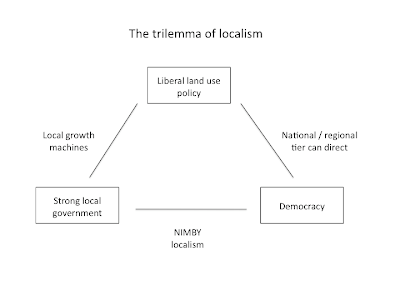 No doubt this is a little too neat, but I think there's something to it. Which is troubling for people who like all three things in those boxes.

I wonder whether a similar logic applies to 'localism' and land use policy, as follows
- Strong local governments which are also very responsive to the local electorate are more likely to be NIMBYist;
- If you want to combine democratic institutions and liberal land use policy you probably need relatively weak local government, with wider interests represented by elected regional or national tiers promoting growth over local resistance;
- And if you want strong local government combined with liberal land use policy then a somewhat undemocratic 'local growth machine' is perhaps the best way to get it.
Or if you prefer the graphic version:

Monday, 19 September 2011
The Gated City
I've just finished reading Ryan Avent's book The Gated City, which UK readers can download for Kindle or PC/Mac reading here. Anyone interested in why we've got cities in the first place, how we ended up with the ones we have, or what's going to happen to them in future should read it. In an appealingly concise ninety or so pages, you get a very clear explanation of the economic advantages of density, a compelling argument that restricting density leads to significant damage to economic growth prospects as well as social costs, and a critique of the ethics of NIMBYism which is all the more persuasive because it is so even-handed.
For a short book it raises a lot of issues, but I'm going to focus on just one or two. Firstly - and maybe this isn't a particularly fair comment on a deliberately brief tome - at some point I'd like to see a deeper exploration of why so many people have come to oppose development so much. After all, it was only as recently as the mid-1970s that Harvey Molotch was writing about how American cities were controlled by 'local growth machines', mostly driven by real estate developers, that rode roughshod over the interests of ordinary residents.
In a way, it's these growth machines that seem hard to explain now. You can see why residents wanted more control, even leaving aside some of the crimes committed in the name of urban redevelopment. It is natural to want to influence what happens to our neighbourhood, since it affects our quality of life so deeply. It is all the more natural if we are particularly attached to our neighbourhood, if it is particularly unique and attractive, or if our major asset's value is intimately tied to it (in practice, these different factors may be difficult to disentangle). Perhaps NIMBYism, like cleaner environments and longer holidays, is something that we choose to have more of as we become more affluent, even if it comes at the cost of lower overall economic growth (I say 'we', but of course as Ryan says there are real clashes of interest and distributional consequences involved).
And the thing is, falling urban densities over the course of the 20th century did seem to be accompanied by real improvements in quality of life. Present day San Francisco is an extraordinarily pleasant place. So why should those who have paid so much for the pleasure of living there have to accept it being changed, perhaps destroyed?
The Gated City is about answering that question from the perspective of society at large, and it answers it very well. But as persuasive as this rootless technocrat found it I don't think it will win over your average NIMBY in San Jose or Chelsea. So what would work? Ryan mainly suggests radically narrowing the scope of planning rules and respecting the right of people to do what they like with their property, and 'zoning budgets' so that local authorities can't restrict development in one place without freeing it up elsewhere.
I'm not sure about these. One problem with trying to radically limit the role of planning is that restrictive rules are typically extremely popular with local people, so removing them implies some sort of top-down direction that, however beneficial in the aggregate, is likely to cause a good deal of strife. Secondly, I think there is a role for planning in that there really are large potential social costs involved with development which good planning can address. There's a danger that removing the system's ability to address these externalities would just lead to more development with high social costs. The problem is that the role of planning has been left open to addressing any kind of 'impact', so people complain on purely private grounds, albeit sometimes dressed up in social terms. Perhaps I'm naive or just speaking my class interests as a sometime-planner (by the way, see the disclosure at the end of the post), but I'd like to see more of an effort to make it clearer which external costs planning can and should address and what the evidential thresholds for complaints should be before we chuck out planning altogether. As for zoning budgets, unless I'm missing something they don't seem to me to really address the legacy of existing constraints.
So what's left? I do think we could look at ways of ensuring that expensive and restrictive neighbourhoods bear more of the costs of their restrictions, which at the moment are mainly borne by others. In this country the new government has introduced a New Homes Bonus which pays local authorities for each new home completed in their area by matching the council tax income for the new home for the first six years. This will provide some additional incentive to increase supply, but the problem is that if supply increases to anything like the levels we need, much of the funding for the NHB will come from top-slicing central government grant to councils in proportion to the amount they currently receive. This means that those councils most dependent on government grant (i.e. those in deprived areas) will pay more for the NHB (if it ever takes off), unless they can get a lot of homes built themselves. In effect therefore, the strongest incentives tend to apply in the areas with lowest market demand.
I've argued that you could redesign the NHB so that it is paid for by top-slicing grant to councils in proportion to the extent of the affordability problem in each area. That would mean that the areas with highest prices relative to incomes will not just earn no NHB if they don't allow new supply, but would lose out the most in proportionate terms to those councils that are building. At the right rates this could be a sharp incentive indeed, perhaps enough to concentrate minds in some expensive areas places (this is also not a million miles from Glaeser & Gyourko's proposal of a few years back).
Now, that's obviously fairly top-down too. And anything that challenges the status quo enough to really make a change is going to be controversial and hard to implement for precisely that reason. The first step has to be to face up to the real magnitude of the costs we impose on ourselves by unduly limiting densities, and for that reason The Gated City deserves to be read very widely.
Disclosure: This post, like everything else on this blog, is informed by my work at the Greater London Authority on housing and planning policy - as a fairly minor functionary rather than someone with much decision-making power. The big decisions are naturally made by the Mayor and his advisors, taking into account a range of factors which I have the luxury of not having to deal with. Just in case it isn't clear, I'm writing in a completely personal capacity here.
For a short book it raises a lot of issues, but I'm going to focus on just one or two. Firstly - and maybe this isn't a particularly fair comment on a deliberately brief tome - at some point I'd like to see a deeper exploration of why so many people have come to oppose development so much. After all, it was only as recently as the mid-1970s that Harvey Molotch was writing about how American cities were controlled by 'local growth machines', mostly driven by real estate developers, that rode roughshod over the interests of ordinary residents.
In a way, it's these growth machines that seem hard to explain now. You can see why residents wanted more control, even leaving aside some of the crimes committed in the name of urban redevelopment. It is natural to want to influence what happens to our neighbourhood, since it affects our quality of life so deeply. It is all the more natural if we are particularly attached to our neighbourhood, if it is particularly unique and attractive, or if our major asset's value is intimately tied to it (in practice, these different factors may be difficult to disentangle). Perhaps NIMBYism, like cleaner environments and longer holidays, is something that we choose to have more of as we become more affluent, even if it comes at the cost of lower overall economic growth (I say 'we', but of course as Ryan says there are real clashes of interest and distributional consequences involved).
And the thing is, falling urban densities over the course of the 20th century did seem to be accompanied by real improvements in quality of life. Present day San Francisco is an extraordinarily pleasant place. So why should those who have paid so much for the pleasure of living there have to accept it being changed, perhaps destroyed?
The Gated City is about answering that question from the perspective of society at large, and it answers it very well. But as persuasive as this rootless technocrat found it I don't think it will win over your average NIMBY in San Jose or Chelsea. So what would work? Ryan mainly suggests radically narrowing the scope of planning rules and respecting the right of people to do what they like with their property, and 'zoning budgets' so that local authorities can't restrict development in one place without freeing it up elsewhere.
I'm not sure about these. One problem with trying to radically limit the role of planning is that restrictive rules are typically extremely popular with local people, so removing them implies some sort of top-down direction that, however beneficial in the aggregate, is likely to cause a good deal of strife. Secondly, I think there is a role for planning in that there really are large potential social costs involved with development which good planning can address. There's a danger that removing the system's ability to address these externalities would just lead to more development with high social costs. The problem is that the role of planning has been left open to addressing any kind of 'impact', so people complain on purely private grounds, albeit sometimes dressed up in social terms. Perhaps I'm naive or just speaking my class interests as a sometime-planner (by the way, see the disclosure at the end of the post), but I'd like to see more of an effort to make it clearer which external costs planning can and should address and what the evidential thresholds for complaints should be before we chuck out planning altogether. As for zoning budgets, unless I'm missing something they don't seem to me to really address the legacy of existing constraints.
So what's left? I do think we could look at ways of ensuring that expensive and restrictive neighbourhoods bear more of the costs of their restrictions, which at the moment are mainly borne by others. In this country the new government has introduced a New Homes Bonus which pays local authorities for each new home completed in their area by matching the council tax income for the new home for the first six years. This will provide some additional incentive to increase supply, but the problem is that if supply increases to anything like the levels we need, much of the funding for the NHB will come from top-slicing central government grant to councils in proportion to the amount they currently receive. This means that those councils most dependent on government grant (i.e. those in deprived areas) will pay more for the NHB (if it ever takes off), unless they can get a lot of homes built themselves. In effect therefore, the strongest incentives tend to apply in the areas with lowest market demand.
I've argued that you could redesign the NHB so that it is paid for by top-slicing grant to councils in proportion to the extent of the affordability problem in each area. That would mean that the areas with highest prices relative to incomes will not just earn no NHB if they don't allow new supply, but would lose out the most in proportionate terms to those councils that are building. At the right rates this could be a sharp incentive indeed, perhaps enough to concentrate minds in some expensive areas places (this is also not a million miles from Glaeser & Gyourko's proposal of a few years back).
Now, that's obviously fairly top-down too. And anything that challenges the status quo enough to really make a change is going to be controversial and hard to implement for precisely that reason. The first step has to be to face up to the real magnitude of the costs we impose on ourselves by unduly limiting densities, and for that reason The Gated City deserves to be read very widely.
Disclosure: This post, like everything else on this blog, is informed by my work at the Greater London Authority on housing and planning policy - as a fairly minor functionary rather than someone with much decision-making power. The big decisions are naturally made by the Mayor and his advisors, taking into account a range of factors which I have the luxury of not having to deal with. Just in case it isn't clear, I'm writing in a completely personal capacity here.
Wednesday, 14 September 2011
Empty homes not to the rescue
Simon Jenkins attacks the NPPF again, and as before the effect is to make you wonder if it's such a bad idea after all. But I just want to pick up on a couple of points he raises. First, there's this:
Speculative investment in housing or land assets is not productive, so maybe that's what Jenkins is thinking of. But increasing housing supply to a higher and hopefully stable new level would be a way to reduce this non-productive type of investment, while increasing the productive kind.
Jenkins then honours a time-honoured tradition by arguing that planning reforms are not needed to boost housing supply because of the "750,000 houses lying long-term empty, thanks to the chronic inadequacy of property taxation". This is wrong in two ways. First, in pure factual terms the recorded number of long-term empty homes (i.e. empty for six months or more) in England is 300,000 rather than 750,000, which is roughly the overall total including short-term empties (see table 615 here).
Secondly, and this is something which hardly anyone who raises the specter of empty homes ever properly addresses, the fact is that the places with the most empty homes are also the places with the least housing demand. This really shouldn't be that surprising when you think about it. Broadly, empty homes tend to be most common in areas with an excess of supply over demand, which are obviously not the same as those places which have the greatest excess of demand over supply.

The chart above illustrates the point. There is a clear negative relationship at the regional level between the rate of long-term empty homes and average house prices. Southern regions (including London) tend to have high house prices and low rates of vacancy, while Northern regions tend to have (relatively) low house prices and high rates of vacancy. We can't move all those empty homes to where the people who want housing are, and the people who want housing are strikingly reluctant to move to where the empty homes are, so maybe we do need to build homes where people want to live after all?
As for housing, it might seem odd in a recession for a chancellor to be directing savings (and bank loans) from productive investment into the housing market.That's a bit backwards. Investment in new housing supply is productive, because it's producing something - new houses! There might be more productive investments around, but given the lack of business investment at the moment the idea that spending on new homes would have a big crowding-out effect is way off.
Speculative investment in housing or land assets is not productive, so maybe that's what Jenkins is thinking of. But increasing housing supply to a higher and hopefully stable new level would be a way to reduce this non-productive type of investment, while increasing the productive kind.
Jenkins then honours a time-honoured tradition by arguing that planning reforms are not needed to boost housing supply because of the "750,000 houses lying long-term empty, thanks to the chronic inadequacy of property taxation". This is wrong in two ways. First, in pure factual terms the recorded number of long-term empty homes (i.e. empty for six months or more) in England is 300,000 rather than 750,000, which is roughly the overall total including short-term empties (see table 615 here).
Secondly, and this is something which hardly anyone who raises the specter of empty homes ever properly addresses, the fact is that the places with the most empty homes are also the places with the least housing demand. This really shouldn't be that surprising when you think about it. Broadly, empty homes tend to be most common in areas with an excess of supply over demand, which are obviously not the same as those places which have the greatest excess of demand over supply.

The chart above illustrates the point. There is a clear negative relationship at the regional level between the rate of long-term empty homes and average house prices. Southern regions (including London) tend to have high house prices and low rates of vacancy, while Northern regions tend to have (relatively) low house prices and high rates of vacancy. We can't move all those empty homes to where the people who want housing are, and the people who want housing are strikingly reluctant to move to where the empty homes are, so maybe we do need to build homes where people want to live after all?
Wednesday, 7 September 2011
Let's get dense
I've been reading Ryan Avent's new book The Gated City, and it provides some good arguments in favour of the point I was making about prosperous cities needing to grow up as well as out.
As I said, in the debate over the National Planning Policy Framework I think there has been an undue focus on the virtues of making land on urban fringes available to develop at low prices, because that will lower costs for businesses and households. Avent's argument, as I understand it, is that we should be most concerned with the costs facing high-productivity or highly growth-promoting firms (and the people they employ), and they are much more likely to want to locate in dense urban areas because of the positive impact of density on productivity, innovation and entrepreneurship. So we should be at least as worried about restrictions on densifying in city centres as we are about restrictions on expansion of suburban areas.
You could argue that this is a false opposition and that cheaper land on the fringe will reduce pressure on the centre. The problem is I'm not sure the two locations are good substitutes. To generalise a bit crudely, those that like fringe locations - sprawl developers, lovers of low density housing and low productivity firms- will benefit from cheaper fringe land, while those who don't - higher density developers, lovers of higher density areas and higher productivity firms - will not. Of course, compact, well-planned urban expansion could potentially give us the best of both worlds, but we don't seem to be very good at that in this country and the current draft of the NPPF doesn't really encourage it.
The bottom line is that real estate prices are generally highest in urban centres. Insofar as that represents the market signalling something, it is a strong signal to build more in urban centres, and only a weak signal to build more on suburban fringes. 'Land supply' isn't everything, at least as it's generally conceived: what we are allowed to do with already-developed land is just as important.
As I said, in the debate over the National Planning Policy Framework I think there has been an undue focus on the virtues of making land on urban fringes available to develop at low prices, because that will lower costs for businesses and households. Avent's argument, as I understand it, is that we should be most concerned with the costs facing high-productivity or highly growth-promoting firms (and the people they employ), and they are much more likely to want to locate in dense urban areas because of the positive impact of density on productivity, innovation and entrepreneurship. So we should be at least as worried about restrictions on densifying in city centres as we are about restrictions on expansion of suburban areas.
You could argue that this is a false opposition and that cheaper land on the fringe will reduce pressure on the centre. The problem is I'm not sure the two locations are good substitutes. To generalise a bit crudely, those that like fringe locations - sprawl developers, lovers of low density housing and low productivity firms- will benefit from cheaper fringe land, while those who don't - higher density developers, lovers of higher density areas and higher productivity firms - will not. Of course, compact, well-planned urban expansion could potentially give us the best of both worlds, but we don't seem to be very good at that in this country and the current draft of the NPPF doesn't really encourage it.
The bottom line is that real estate prices are generally highest in urban centres. Insofar as that represents the market signalling something, it is a strong signal to build more in urban centres, and only a weak signal to build more on suburban fringes. 'Land supply' isn't everything, at least as it's generally conceived: what we are allowed to do with already-developed land is just as important.
Tuesday, 6 September 2011
People should read Ryan Avent and Andrew Lainton
Just a quick post to point anyone interested in housing and planning issues towards two people currently writing up a storm on these issues.
Ryan Avent blogs for the Economist but has a long-standing interest in urban economics and housing in particular. He has just come out with a slim Kindle-only book, The Gated City, which is concerned with the negative aggregate consequences of anti-density building restrictions in America's most productive places, its cities. I'm reading it at the moment and am very impressed, and incidentally the argument applies just as much to London as it does to San Francisco. Ryan wrote an op-ed for the NY Times summarising the book here.
Then there's Andrew Lainton, who I hope everyone with a passing interest in the NPPF debate is following. It's always good to see someone who manages to be both expert and consistently interesting writing so much, but with the kerfuffle about the NPPF I think Andrew has really found his issue, and he deserves that shout-out from George Monbiot today.
Ryan Avent blogs for the Economist but has a long-standing interest in urban economics and housing in particular. He has just come out with a slim Kindle-only book, The Gated City, which is concerned with the negative aggregate consequences of anti-density building restrictions in America's most productive places, its cities. I'm reading it at the moment and am very impressed, and incidentally the argument applies just as much to London as it does to San Francisco. Ryan wrote an op-ed for the NY Times summarising the book here.
Then there's Andrew Lainton, who I hope everyone with a passing interest in the NPPF debate is following. It's always good to see someone who manages to be both expert and consistently interesting writing so much, but with the kerfuffle about the NPPF I think Andrew has really found his issue, and he deserves that shout-out from George Monbiot today.
Subscribe to:
Comments (Atom)