Showing posts with label history. Show all posts

Sunday, 12 May 2013

History and cycling's mode share in Amsterdam and London

This presentation by RenĂ© Meijer of the City of Amsterdam has a useful chart showing the transport mode split in Amsterdam by the length of the journey.

I've tried to recreate it for London, using data from the London Travel Demand Survey downloaded from TfL's Romulus website*. It's not possible to make an exact comparison, for a few reasons:
  • For London I use data on journey 'stages', which includes things like walking to the bus stop. It's not clear whether the Amsterdam data uses data on stages or on the main mode used for a trip from A to B.
  • The journey distance categories are slightly different between the two cities.
  • I've included motorcycle journeys in the 'car' category in London, but it's not clear whether or how they are counted in Amsterdam.
With those caveats in mind, here's the London chart.
Note, I've tried to use similar colours, so the reason there's lots of red in the Amsterdam chart and hardly any in the London chart is that lots of people cycle in Amsterdam and hardly anyone cycles in London. The difference is huge, and seems to be made up by a mix of more travel by car and by public transport in London for trips of between 0.5 and 10 km.

London's high public transport share for medium-length trips (predominantly bus until for trips of up to 6km and predominantly Underground/DLR thereafter) is striking, and I think a little under-discussed in the debate about growing cycling. We have a pretty wonderful public transport network that competes against cycling both in terms of attracting passengers and, in the case of buses, for road space. Even though there is definitely scope for huge growth in cycling with the right policies in place, this starting point probably means we're unlikely to match Amsterdam's modal share even for trips of the same length. Cities can't choose their history, and that can make a huge difference to their future.

* You'll need to request a password to access the full site.

Tuesday, 19 February 2013

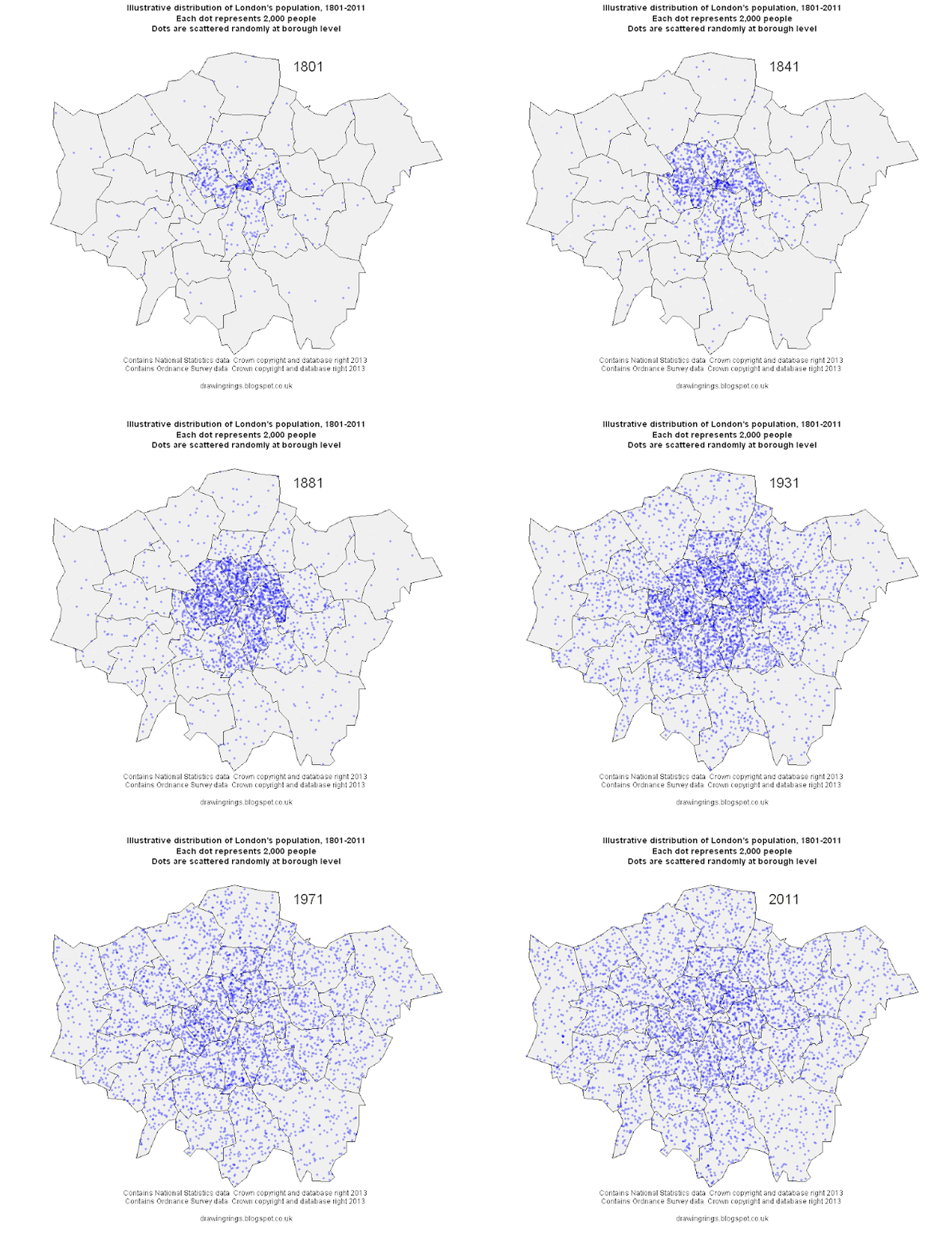
Animating London's population change 1801-2011

Over the last couple of hundred years London's population has grown and spread out on a vast scale. This process has involved a remarkable deconcentration of population from the centre to the suburbs: in 1801 the vast majority of its million people were crammed into a few central boroughs, with the square mile of the City of London holding 129,000 people. The population of the city grew by more than 5 million over the next century with the vast majority of that growth in the inner suburbs opened up by public transport. Over the course of the 20th century suburbanisation accelerated with the advent of the car, only for population growth to pick up again in the centre in the last few decades.

Summing up all this change in a single graphic is quite a challenge, so instead I've made this simple animated map, illustrating the changes in population using a dot-density approach where every dot represents 2,000 people. The dots are randomly distributed at borough level at the point of each Census starting in 1801 and ending in 2011, so they are not meant to represent the exact locations of individual settlements.


The maps were made in R using data from the Census (downloaded from the London Datastore and updated with 2011 data) and boundaries from the Ordnance Survey. The animation was done in UnFREEz as I couldn't get the native animation in R to work.

Tuesday, 11 December 2012

What do homeowners have a stake in?

Today's Census figures showing a fall in home ownership have excited plenty of comment about the struggles of so many people to get on the property ladder. With excellent timing, the IPPR came out with some research yesterday examining some of the knock-on effects of these housing pressures. Jenny Pennington, the author of the research, summarises the argument here. I recommend people read the full report as it has some really good qualitative evidence on the social consequences of high housing costs, such as people having to delay starting relationships or having children. But there's one particular result I'd like to focus on. Jenny writes:
Secure housing also makes a real difference to the way people invest in a particular community. Owning a home increases a person's sense of belonging to a neighbourhood. For example, an individual who has lived in the same home for 20 years without owning it is likely to feel the same sense of neighbourhood belonging as someone who owns their home, but has lived in it for just six years. Young people who did not own their home talked about not really seeing the point of committing to the area in which they lived or getting to know the people they shared a street with.
This conclusion is arrived at through a robust-looking analysis of survey data, and I'm sure it's accurate as far as it goes. I would just caution that it's very hard to control for all the relevant factors here, particularly the crucial one of how long people intend to stay in a neighbourhood. Someone who expects to be moving on in a few years is likely to be less keen to either buy a home (given the transaction costs involved) or get much involved in local community matters. If the average level of 'expected mobility' in the population rose (because more people need to move to find work, for example), then we should probably expect to see both less home ownership and less 'neighbourhood belonging' - but home ownership wouldn't be the causal factor.

That said, I suspect there probably is a positive effect of homeownership on community belonging, even if it is hard to identify empirically. Pure self-interest would suggest that homeowners are likely to be more committed to the improvement of their area, because when you own a home somewhere you are to some extent stuck there (transaction costs again), and the value of your (very large) financial investment will be determined by what does or doesn't happen in its surroundings.

Lest anyone think I'm just being cynical for the sake of it, there is some pretty good evidence that homeowners' attitudes towards community issues are influenced by the expected impacts on house prices. Here's Christian Hilber, writing in the Journal of Urban Economics in 2010:
This paper examines the role of local housing supply conditions for social capital investment. Using an instrumental variables approach and data from the Social Capital Community Benchmark Survey, it is documented that the positive link between homeownership and individual social capital investment is largely confined to more built-up neighborhoods (with more inelastic supply of new housing). The empirical findings provide support for the proposition that in these localities house price capitalization provides additional incentives for homeowners to invest in social capital. The findings are also largely consistent with the proposition that built-up neighborhoods provide protection from inflows of newcomers that could upset a mutually beneficial equilibrium involving reciprocal cooperation.
Translated, what this means is that home owners really do put more effort into building social ties ('social capital investment'), but only really in places where it's harder to build new housing ('more inelastic supply'). One possibility is that this is because in such areas any local improvements as a result of stronger social ties are more likely to result in higher house prices, while in areas with elastic supply rising demand results in more new homes and no effect on prices. It's worth noting that Dr Hilber previously found that in Massachusetts even elderly homeowners without kids tend to vote for (and pay for, through taxes) investment in schools because it increases the value of their home.

Many people might say there's nothing wrong with any of this, and that if home ownership gives people a financial incentive to care more about their neighbourhood then so much the better for home ownership. My concern is that it also seems to give people a financial incentive to oppose new housing supply in their neighbourhood, as new development may reduce the value of their home (either through a supply effect or the amenity impact of extra housing) or, as Dr Hilber suggests, upset the social balance they have helped create. If homeowners are really less likely to be socially virtuous when housing is plentiful then it sounds like a society with high levels of home ownership and strong social ties may also be one with a persistent housing shortage.

And indeed, that's kind of what the basic numbers suggest. Surveys show that a sizeable majority of home owners say they would oppose new homes being built in the local area, while private tenants are basically split and social housing tenants are in favour of new housing. And over the long run, the rate of new housing supply has fallen while the rate of home ownership has risen. The graph below charts one against the other for England as a whole, starting in 1972 and ending in 2011. Throughout most of the 1970s we were building around two new homes for every new household, but over time, the rate of building fell as the rate of home ownership rose. There was obviously a lot of other stuff going on at the time so I'm not categorically claiming a causal relationship, but it's not a particularly positive picture either.


To sum up, I'm not sure home ownership gives people a stake in 'society' so much as it gives them a stake in their local neighbourhood, which is not the same thing, especially if one way to 'help your neighbourhood' is to prevent new homes being built there. That may make sense from a household's perspective (in fact for many people it certainly does) but that doesn't mean it makes sense for society as a whole.

Wednesday, 24 October 2012

Urban expansion: learning from 19th century London


Paul Collier says that African cities should learn from the example of 19th century London when it comes to housing policy. London was able to build decent housing for working people because its building regulations weren't onerously high, because landowners split their land up into separate plots for small firms to build out while retaining ownership themselves, and because the legal system of ownership and tenure was clear enough to allow building societies to lend with confidence.

All good points, but I would just a couple of things. First, 19th century London also benefitted from rapidly falling transport costs, which enabled development to take place on greenfield land. Stagnation in transport technology makes it harder to keep expanding the urban frontier and compels us to try and redevelop existing urban areas.

Also, it's not just African cities but 21st century English cities which could learn from the example of Victorian London, in particular on the land ownership front. What usually happens these days is that a developer buys a large site and then waits for the most opportune moment to develop the whole thing, which can take a long time. This arrangement means you are basically creating a local land monopolist, with all the problems that entails. Ideally, government should instead try to split the task of building the site out between a number of smaller firms, who would then be competing against each other, which should raise both the timeliness and the quality of development. Obviously this is much harder when government doesn't own the land, although the German practice of umlegung (land assembly) seems to be a reasonably close approximation.

Monday, 3 September 2012

The amazing fall in urban crime rates, and the downside

The Economist has an article about the sharp decline in crime in American cities since the early 1990s, noting that there is no consensus over what caused it. This disagreement isn't that surprising since so many factors may be contributing to crime at once, and since the debate also has some ideological and political significance.

But it is really worth emphasising just how large has been the drop in crime in US cities, because it's important not just on its own terms but for what it says about where our cities are headed. The longest reliable historical record of crime in US cities is probably the homicide rate in New York City, which the late Eric Monkkonen compiled for every year between 1800 and 1999. You can find his data series here. It includes not just the number of homicides but the rate per 100,000 residents, and I have updated the series to 2011 with homicide data from the NYPD and population data from Wikipedia

I think there is good evidence for the theory that lead poisoning (from car exhaust and lead paint) had a lot to do with these trends, partly because it helps explain why crime rates fell not just in the US but across Europe too (see Kevin Drum on this subject, including relevant links). I'm sure improvements in policing helped too. But in a way what caused the fall in crime is less interesting than what knock-on effects it will have.

People understandably put a high value on safety and are willing to pay a price premium to live in low-crime areas. So you would expect the fall in urban crime levels to have contributed to higher urban house prices, and at least in the case of New York you would be right - this research estimates that falling crime rates explain about a third of the mid-1990s increase in NYC house prices.

These price rises show that people really value the safer urban environments created by lower crime. But higher housing costs may not be good news for everyone, especially tenants facing higher rents. If New York City had built a lot of new housing to cope with rising housing demand it would have been able to moderate (but probably not eliminate) these price increases and allow more people to enjoy living in a great city with falling crime rates, but instead higher demand fed straight into higher prices. It would be tragic if this pattern was repeated elsewhere and low-income people pushed out of cities just as they finally become more liveable.

Monday, 16 January 2012

Long-run trend in commuting into central London

[Cross-posted to London Transport Data]

The first statistics on commuting into central London were collected in the 1850s (of which more later), but the first figures comparable to the present date from around a century later. The chart below shows the trend since 1956 in the number of people (in thousands) measured as entering central during the weekday morning peak, broken down by whether they used rail (national rail, London Underground or TfL), bus or private transport (car, coach, taxi, cycle and motorcycle). NB, walking isn't included.


The number of morning commuters peaked at about 1.25 million in 1962 and then fell through most of the next twenty years. The pattern over the last thirty years is dominated by peaks and troughs linked to London's economic performance, with notable booms and busts in the late 1980s, early 2000s and in 2007-08. Rail is the dominant mode throughout this period, even more so in recent years, reaching 79% of the total in 2010. In fact the more interesting changes happened on the road and only really show up when you leave rail out. Detailed data on road traffic only starts in 1969 but the chart below interpolates back to estimates from 1961 to show the broad modal split of road commuting over a nearly 50-year span. It shows buses and cars twice swapping places as the dominant mode of transport for commuters, with bus ridership sliding throughout the 60s and 70s before shooting up again in the early 2000s. Interestingly, this latter shift seems to have started before the introduction of the congestion charge: the number of car commuters into central London fell by nearly a quarter between 2000 and 2002, before the C-charge was introduced in 2003.


The most notable trends in the last decade have been the continuing fall in the car share of commuting, and the rise in cycling. The chart below shows cycling's share of road commuting into central London since 1969. In the early 1970s cycling accounted for just 1% of road commuting (and therefore a much smaller share of total commuting), but by 2010 this had risen to 12%. Given the combined motorcycle/cycle figure in 1961 was 13%, it seems fairly plausible that cycling now accounts for a higher share of central London commuters than at any point in the past. Also, if current trends continue (a big if) it won't be long before more people are coming into central London on two-wheelers than in cars.


I mentioned at the start that these kind of statistics were first collected in the 1850s. This refers to a survey by Charles Pearson, who hired 'traffic-takers' to stand 'at all the principal entrances to the city of London, to take their station from eight o’clock in the morning till eight o’clock at night' and count the number of persons and vehicles leaving or entering the City over the twelve-hour period. The City was a much larger part of 'London' in the 1850s than it is now, and Pearson measured somewhat different flows and used a different methodology, but his results, shown in the table below, are still fascinating.  

Estimated number of persons and vehicles going into and out of the City daily in 1854, counting them all both ways.
Omnibus 88,000
Other vehicles 52,000
River steamers 30,000
Via Fenchurch St and London Bridge rail 54,000
Foot passengers 400,000

Railways were still in their infancy and there was no Tube yet, but the most striking result here is how many people walked into Central London. That's not so surprising, as London was much smaller and denser than it is today so most people would have been within an hour's walk of the City. It's frustrating that we don't have comparable figures on walking today (at least, not that we could easily find) but as the city is so much more spread out you would expect walking's share to be much lower, though still significant.